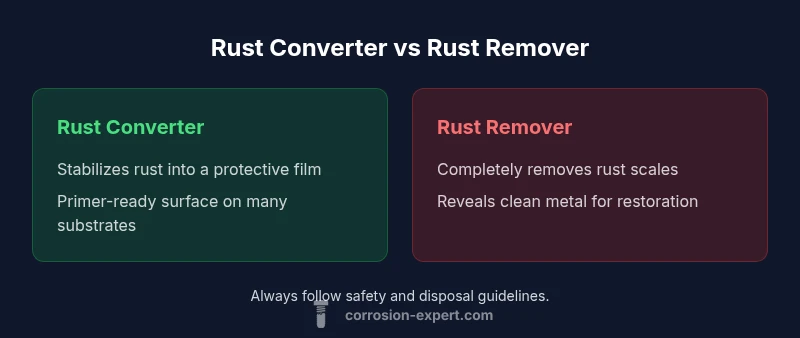
Rust Converter vs Rust Remover: A Practical DIY Guide
Analytical comparison of rust converter vs rust remover for DIY projects. Learn how each works, ideal applications, safety, and how to choose the right rust treatment for various surfaces and finish goals.


According to Corrosion Expert, choosing between rust converter vs rust remover depends on rust severity, surface prep, and finish goals. This comparison clarifies how each product works, when to choose them, and how to pair them with primers for long-lasting protection. For DIYers, understanding the difference helps save time and avoid costly rework. The article also highlights practical tips and safety considerations.
What are rust converter and rust remover?
Both rust converter and rust remover are common rust treatments used by homeowners. They solve different problems and require different preparation. In the ongoing debate about rust converter vs rust remover, the core distinction is that converters stabilize corrosion while removers physically remove oxide scales. A converter typically reacts with iron oxide to form a protective film, whereas a remover uses acid or chelating agents to lift rust from the metal surface. The result is a ready-to-coat substrate, but not all projects benefit from one approach over the other. According to Corrosion Expert, choosing the right method begins with assessing rust severity, substrate type, and your desired final finish. In practice, most DIYers favor converters for light-to-moderate rust when time and priming efficiency matter, while removers find use when heavy, pitted rust must be eliminated before finishing.
How rust converter works
Rust converters typically contain tannins or phosphoric acid derivatives that chemically react with the iron oxide to form a stable, inert layer. This layer is designed to adhere to the metal and provide a primer-friendly surface for paint or sealant. The chemistry aims to lock rust into a durable film, reducing rust progression under coatings. Many modern converters are water-based, which makes cleanup easier and safer for DIY projects. However, performance depends on the rust’s condition; converters work best when rust is dry, light to moderate, and the surface is structurally sound enough to accept the film. The Corrosion Expert team notes that effectiveness rises when the converter is applied in proper thickness and given adequate cure time before priming.
How rust remover works
Rust removers use acids (phosphoric or oxalic common), or chelating agents, to dissolve corrosion and lift it away from the metal. This process reveals bright metal and a cleaner surface but may require scrubbing, rinsing, and sometimes neutralization to return the pH to safe levels. Removers are often used on heavily rusted areas or on parts with deep pitting where stabilization alone won’t suffice. The result can be bare metal or a lightly oxidized surface that requires sealing promptly to prevent new rust. The choice depends on whether you want deep cleaning and restoration or a ready-to-paint surface after treatment.
When to choose rust converter vs rust remover
Choosing between rust converter vs rust remover hinges on rust severity, project scale, and finish goals. For light to moderate surface rust where you plan to prime or paint soon, a converter offers an efficient route: stabilize, seal, and simplify prep. If rust forms have already penetrated the substrate, or you need bare metal for a flawless finish, a rust remover provides more aggressive cleaning. Consider the surface type: soft metals may react differently than hard steel; the environment (indoors vs outdoors) affects protection duration; always follow label directions and perform a test patch before full application. The decision is rarely absolute; many DIYers use a converter for the initial pass and switch to a remover on stubborn patches, balancing time, cost, and final quality.
Application tips and prep for best results
Surface prep is critical for both products. Start by removing loose rust with a wire brush or sanding, then wipe with a damp cloth to remove dust. For converters, ensure the surface is dry and free of grease; apply evenly, avoiding puddles, and allow the film to cure according to the manufacturer’s guidance. For removers, protect nearby plants and metals, work in a well-ventilated area, and rinse thoroughly after treatment. In all cases, neutralize or seal the surface after treatment to prevent new rust, especially if the plan includes painting or sealing. Always wear eye protection, gloves, and a mask when dealing with chemical products.
Surface outcomes and coating compatibility
Rust converter creates a sealed layer that serves as a base for paint, primer, or sealant; some formulations claim to be ready for topcoat the same day, while others require a cure period. Rust remover reveals clean metal, which typically needs immediate protection with primer or paint to prevent new oxidation. The decision affects coating compatibility: converters may leave a film that must be compatible with your primer, while removers may require a neutral rinse and degrease. For galvanized, stainless, or aluminum surfaces, verify compatibility, as some products can cause discoloration or poor adhesion. In all cases, perform a test patch to confirm bonding and finish.
Real-world scenarios and decision guidance
Scenario A: A vintage garden bench with light rust asks for a quick refresh. A rust converter can stabilize the surface and let you finish with paint or protective varnish. Scenario B: An automotive frame with heavy surface rust needs thorough cleaning. A rust remover followed by primer and rust-inhibiting paint provides the best long-term protection. Scenario C: Outdoor tools with intermittent exposure to moisture benefit from a converter as a primer-ready base, while tools with severe corrosion require aggressive cleaning first. The key is to align your method with the rust’s extent and exposure.
Safety, disposal, and environmental considerations
Many rust products contain acids or tannins; use gloves, eye protection, and ventilation. Read the label for safe handling, storage, and disposal—some regions require special waste handling for solvents. Neutralize acidic residues where appropriate, and recycle or dispose of containers per local rules. Keep pets and children away during application. Environmentally conscious DIYers prefer water-based formulations and minimal volatile organic compounds (VOCs) when possible, and will seek products that provide clear guidance on safe disposal.
Quick-start workflow for DIY projects
For DIYers who want a practical workflow, follow these steps: 1) assess rust scope; 2) select rust converter or remover based on severity; 3) prepare the surface; 4) apply per label; 5) allow cure or dwell time; 6) seal with primer or protective coating; 7) inspect after a few days for signs of new rust.
Comparison
| Feature | Rust Converter | Rust Remover |
|---|---|---|
| What it does | Chemically converts ferric oxide (rust) into a stable film | Chemically removes rust by dissolving oxide layers |
| Typical application | Light to moderate rust; primer-ready surface | Heavy rust or deeply pitted areas; bare metal prep |
| Surface outcome | Sealed, paint-ready film | Clean metal or bright surface needing sealing |
| Ease of use | Generally quick; minimal mechanical effort | More scrubbing and longer cleanup |
| Prep required | Dry, grease-free surface | Thorough cleaning and drying often needed |
| Safety/cleanup | Water-based options common; simple cleanup | May involve acids/chelates; ventilation required |
| Cost range | Low to mid-range | Mid to high-range |
| Best for | Light-to-moderate rust with primer-ready goal | Heavy rust requiring thorough cleaning and restoration |
The Good
- Convenient for quick priming and coating
- Seals rust to reduce further corrosion
- Less aggressive on skin than strong acids in many formulas
- Suitable for indoor projects with controlled environments
Cons
- Not ideal for severe rust or deep pits
- May leave a film that needs proper primer compatibility
- Effectiveness depends on proper surface preparation
- Some products require multiple steps or follow-up coatings
Rust converter is typically the better first step for lightly to moderately rusted surfaces when you want to seal and prime in one step; rust remover is more appropriate for heavy rust and deep cleaning.
For most DIY projects, start with a converter if the rust is light. Reserve remover for stubborn, heavy rust or when bare metal is needed before refinishing. Pair with appropriate primers and coatings for best protection.
Quick Answers
What is the main difference between a rust converter and a rust remover?
A rust converter chemically stabilizes rust into a protective film that can be painted over, while a rust remover dissolves or lifts rust from the surface to expose clean metal. Your choice depends on rust extent and finish goals.
Converter stabilizes rust; remover cleans it off. Pick based on how much rust and the desired finish.
Can I use rust converter over rust remover residue?
Residue from a remover should be cleaned and neutralized before applying a converter. Otherwise, the coating may not adhere properly.
Remove residue first, then apply a converter for best results.
Are rust removers hazardous to pets or indoor air quality?
Many rust removers contain acids or chelating agents; use in a well-ventilated area and keep pets away during application. Follow label directions for safe use.
Ventilate well and keep pets away when using rust removers.
Does a rust converter prevent future rust under paint?
Yes, many rust converters aim to provide a protective underlayer that improves paint adhesion and reduces future rust when used with a compatible primer.
Converters help with primer adhesion and rust prevention under paint.
How long do these products last before applying topcoat?
Durability depends on surface preparation, environment, and the topcoat. Follow label cure times and apply primer or paint within the recommended window.
Follow the product’s cure and topcoat timing for best protection.
Can I use these products on stainless steel or aluminum?
Some rust products are formulated for ferrous metals and may discolor or underperform on stainless steel or aluminum. Check manufacturer guidance before use.
Check the label for nonferrous suitability before applying.
Quick Summary
- Assess rust severity before choosing a product
- Converters are convenient for primer-ready surfaces
- Removers are ideal for heavy rust and thorough cleaning
- Always follow safety and disposal guidelines for rust products