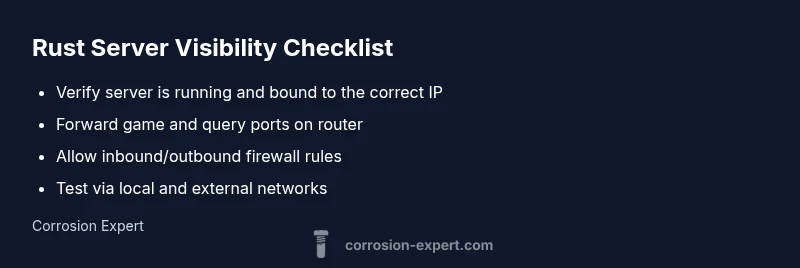
Why Are Rust Servers Not Showing Up? An Urgent Troubleshooting Guide
Urgent troubleshooting guide to fix Rust server visibility. Learn network checks, port forwarding, firewall rules, and Steam settings to get your Rust servers showing up again.


Most likely, rust servers not showing up are blocked by network visibility issues rather than a faulty server. Start with a quick fix: verify the server is running, confirm the correct port is open, and check your firewall and NAT settings so Steam can query the server. If it still doesn’t appear, reboot the router and re-test connectivity.
Quick Network Check: Is the Rust server visible on your local network?
The fastest way to diagnose visibility is to test from within your LAN. Start by ensuring the Rust server process is running on the host machine and bound to the correct local IP. Use a local client or a basic TCP check to verify the server port is reachable on the host. If you cannot reach it locally, the server will not be visible publicly or in Steam. This initial check confirms whether the issue is with the server process or with external access. If the local test passes, you can move to remote checks with a clearer baseline. Document any error messages you see in the console for later reference, as they often point to misconfigurations in binding, port exposure, or binding to an incorrect interface.
Tip: Keep the server console open during testing to catch binding errors or startup warnings early.
Port Forwarding and NAT: Opening the Right Doors
Port forwarding is frequently the gatekeeper of visibility. You typically need to forward the game port and the Steam query port to the server's internal IP so clients outside your network can discover and query it. Verify both ports are forwarded on your router and that they are not blocked by your ISP’s equipment. If your router supports UPnP, enable it temporarily to facilitate testing; otherwise, set static mappings and note them for future changes. If you’re on a shared hosting environment, check whether the provider blocks inbound connections on those ports by default. After updating ports, test from an external network to ensure the changes are effective.
Pro tip: Use a port-check tool from a consumer device on a different network to confirm both ports are reachable.
Firewall Rules and Antivirus Interference
Firewall rules are a common culprit. Ensure inbound and outbound rules permit the Rust server process and the two essential ports. On Windows, create explicit allows for the server executable and both ports; on Linux, configure iptables/ufw accordingly. Don’t forget antivirus software, which can momentarily block traffic during testing. Temporarily disable it to verify visibility, then re-enable with specific allowances. If the server becomes visible after adjusting firewall settings, you’ve pinpointed the blocker. If not, the issue likely lies elsewhere in the chain (router, NAT, or Steam integration).
Note: Always reapply protections after testing to avoid leaving your system exposed.
Steam Server Browser vs. Direct Connect: Understanding the Difference
Steam’s server browser and direct connect behave differently, and visibility mismatches are common. Some users rely on Steam listing while others connect directly via IP. If your server isn’t appearing, test both approaches. Make sure the Steam query port is accessible from outside your network and that Steam can reach the server’s query endpoint. If you can connect directly but not see the server in the browser, the problem is most often Steam-side or related to the server’s registration with Steam. Tracking both pathways helps isolate network versus Steam registration issues.
Tip: Test with a known-good client on a different network to separate Steam-specific issues from your own network.
Server Configuration: Name, Mods, and Query Port Mismatch
A mismatch between your advertised query port and the actual listening port will prevent listing. Verify the server’s name is compliant with Steam’s expectations (avoid problematic characters and excessive length). If mods are enabled, ensure all versions are compatible with the server build; incompatibilities can stop a server from appearing in listings. For a clean baseline, run a mod-free test server to confirm visibility before reintroducing mods. A small misconfiguration here can mask the server from the list even when everything else is working.
Bottom line: keep a simple configuration for initial testing, then layer in mods and custom settings once visibility is confirmed.
When All Else Fails: Reproduce, Logs, and Timing
If the server still doesn’t appear, reproduce the issue with minimal variables: disable mods, use a static IP, and run a fresh server instance. Collect logs from the server console and from SteamCMD to identify where the failure occurs. Remember that changes to NAT, firewall, or router rules can take several minutes to propagate; plan to test for 5–10 minutes after each adjustment to observe real results. If you’ve exhausted the diagnostic flow and the server remains invisible, escalate to hosting provider or Steam support.
Summary: the most reliable path is controlled, incremental changes followed by documented verification in logs.
Quick Recap and Why This Works
By focusing on local binding, port exposure, firewall policies, Steam registration, and clean configuration, you systematically remove the most common visibility blockers. Each step builds a verifiable criterion (local reachability, external port openness, browser versus direct connect outcomes), which accelerates the path to a visible server. This approach is practical for DIY admins and hosting providers alike, and aligns with best practices for online game server visibility.
Steps
Estimated time: 25-40 minutes
- 1
Verify server is running locally
Confirm the Rust server process is up and listening on the expected port. Check console for startup errors and ensure the server binds to the correct IP.
Tip: If you use a container or VPN, ensure port exposure is configured. - 2
Check port forwarding
Log in to your router and ensure the game port and Steam query port are forwarded to the server's internal IP. Save and apply changes, then test from an external network.
Tip: Use an online port check tool to verify openness. - 3
Audit firewall rules
On the host, confirm both inbound and outbound rules permit the game and query ports. Temporarily disable antivirus to test impact, then restore protections.
Tip: Document each change for reproducibility. - 4
Test visibility locally and remotely
From a device on the same LAN, attempt direct connection. Then try an external network to see if the server lists. Compare results to identify network vs Steam issues.
Tip: Record timestamps and outcomes. - 5
Review Steam query parameters
Verify the query port matches the server config and that the server is registered with Steam. Restart Steam services if listing persists unresponsive.
Tip: Check SteamCMD logs for query errors. - 6
Check mods and server name
If mods are used, ensure compatibility with the server you advertise. Keep the server name concise and free of problematic characters that Steam dislikes.
Tip: Run a mod-free test server to isolate issues.
Diagnosis: Rust server not showing up in Steam server list or in-game server browser
Possible Causes
- highIncorrect or blocked ports (game port and Steam query port) not forwarded or blocked by firewall
- highServer not running or binding to the wrong network interface/IP
- mediumSteam query service blocked or server not registered with Steam
- mediumNAT or router issues preventing external visibility
Fixes
- easyOpen and forward the required ports on the router and ensure firewall allows both ports
- easyVerify the server process is running, listening on the expected IP and port, and restart if needed
- mediumRe-register the server with Steam or restart Steam services if needed
- mediumTest from multiple networks and document results; if unresolved, escalate to hosting provider
Quick Answers
Why isn't my Rust server showing up in the server list?
Common causes include blocked ports, firewall rules, NAT issues, or Steam registration problems. Follow the diagnostic flow to verify each point.
Most visibility problems come from blocked ports or NAT; check ports, firewall, and Steam registration.
Do I need to port forward for Rust servers?
Yes. You typically need to forward the game port and the Steam query port to the server's internal IP. Check your router docs for instructions.
Forward the correct game and query ports to your server's IP.
What should I test first if the server isn't visible?
Test local binding and reachability first. If you can't reach the server on your LAN, you won't see it publicly either.
Test local reachability first to rule out basic server issues.
Can mods affect visibility?
Yes; incompatible mods can prevent listing. Use a clean test server to confirm if mods affect visibility.
Mods can block listing; test without mods.
Should I contact hosting provider for visibility issues?
If you can't resolve after trying the diagnostic flow, contact your hosting provider to verify network policies and port exposure.
If unresolved, seek provider or Steam support for listing issues.
How long should I wait after changes?
Allow several minutes for changes to propagate. Re-test after each adjustment and monitor results.
Give it a few minutes to propagate changes.
Watch Video
Quick Summary
- Verify ports are open and forwarded correctly
- Confirm the server is running and listening
- Check Steam query compatibility and registration
- Test visibility from multiple networks