What rust fails an MOT: a practical guide for homeowners
A thorough guide to rust-related MOT failures, how rust is evaluated by testers, and practical steps homeowners can take to prevent corrosion from causing a fail.


What rust fails an MOT depends on safety impact. In short, major structural rust, holes, or thinning in chassis components, subframes, suspension mounts, brake lines, and exhaust sections typically fail. Surface rust on body panels or non-structural areas often does not, but heavy rust that affects integrity or standoff clearance will trigger an inspection failure. Always assume severe corrosion could cause a fail.
What rust means for MOT safety and how the test views corrosion
According to Corrosion Expert, rust is evaluated not just for appearance but for its impact on safety and structural integrity. If you’re asking what rust fails an MOT, testers prioritise areas where corrosion could compromise your vehicle’s ability to perform under test conditions. The MOT regime classifies rust by its potential to undermine critical systems, not by cosmetic surface appearance. In practice, this means small patches of surface rust on a non-structural panel are unlikely to fail, while corrosion that creates holes, penetrates hollow sections, or thins metal around load-bearing points will raise flags during the inspection. The intent is to identify corrosion that could cause a sudden loss of structural support, brake performance, or exhaust integrity.
The keyword here is safety: rust that reduces the thickness of a structural component, or that interferes with a system’s ability to function safely, is the kind of corrosion that MOT testers are trained to identify and fail. It’s essential to understand where rust tends to form first and how its progression alters risk. By knowing these thresholds, you can act early and avoid unexpected failures during your next MOT.
Common rust offenders on vehicles and where they appear
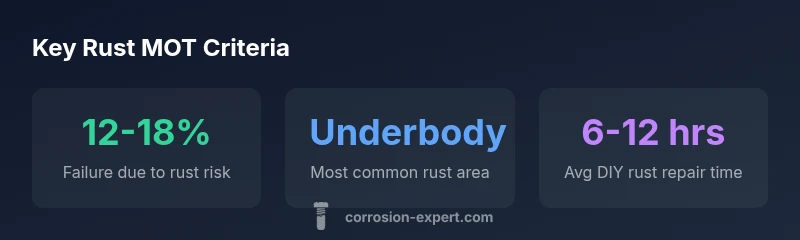
Most rust-related MOT failures originate from predictable weak points on a vehicle’s body and underbody. The wheel arches, sills, jacking points, and the underbody rails are common because they’re constantly exposed to road salt, spray, and impact damage. Rust on brake lines, fuel lines, and exhaust sections represents a direct safety or emission risk, and is more likely to fail once the corrosion penetrates protective layers or forms pinholes. A practical approach is to inspect these areas regularly, particularly after winter or long drives on salted roads. Cosmetic rust on doors or panels may be tolerated if the metal remains sound and intact, but signs of deeper corrosion beneath the surface should be treated promptly to prevent MOT failure.
Another frequent hotspot is the chassis and subframe connections. If corrosion has advanced to the point where mounting points show thinning, cracking, or holes, testers will likely note a fail because the structural integrity could be compromised under load or during a test scenario. In the same vein, structural rust around suspension mountings can affect alignment and safety, which is exactly why that area is closely scrutinised during the MOT.
Seasoned DIYers know to look for rust around the sills, door bottoms, and A-pillars where standing water tends to collect and moisture trap rust. These locations often hide slower-advancing corrosion that, if ignored, culminates in a fail when the vehicle is tested. Regular cleaning, underseal, and prompt repair of any flaked coatings can slow progression and help you pass MOTs more comfortably.
Rust severity and MOT thresholds: when does rust become a fail?
Rust is not a single threshold phenomenon; it’s a progression from surface scale to structural compromise. We distinguish three broad categories to help you assess risk. First, cosmetic/rust on non-structural metal is usually dismissed if the metal thickness remains intact and there are no holes. Second, surface rust that starts to encapsulate critical joints, brackets, or load-bearing points begins to raise concern, especially if it travels beneath protective coatings. Third, any rust that penetrates to the base metal and creates holes, thinning, or cracking in structural areas (such as chassis rails, suspension mounts, or internal hollow sections) is likely to fail the MOT. The tester’s job is to determine whether the corrosion still leaves the metal strong enough to safely carry loads and maintain control. In practice, penetrating rust or suspicious signs near brakes or steering components will prompt a fail.
The best approach is to treat rust early and document repairs. If you’re unsure about a particular area, a professional inspection can provide a reliable assessment; the cost of preventative maintenance often pays for itself by avoiding a failed MOT and subsequent re-test costs.
How testers assess rust during the MOT: process and checklists
MOT testers use a standardized visual inspection to assess corrosion. They look for any signs of holes, thinning, pitting, or flaking that could affect structural integrity or critical systems. The tester may perform a light tapping test to identify soft spots and use tools to gauge the depth of rust in underbody rails or suspension components. Where accessible, they check for corrosion around brake lines, exhaust mounts, fuel lines, and the engine bay’s copper or steel components. In some cases, a moisture or corrosion-prone area may require a more thorough assessment, possibly including a thickness gauge to quantify how far rust has progressed relative to the recommended minimum thickness. If the rust has advanced to a point where safety systems can no longer function as designed, the MOT will be scheduled for a fail.
Preparation for MOT should involve a comprehensive pre-check: wash away salt and grime, inspect welds and joints, and verify that protective coatings are intact. By presenting a vehicle with minimal corrosion and well-maintained critical parts, you give testers the best chance of passing the inspection.
Real-world scenarios: when rust passes vs fails an MOT
In real-world scenarios, many cars with light surface rust pass an MOT when the rust does not threaten structural integrity or critical systems. For example, minor surface rust on body panels or underbody components that doesn’t affect thickness or create holes is often allowed, provided there’s no hidden corrosion. Conversely, a car with a corroded brake line, a perforated chassis rail, or an exhaust section with a hole is at high risk of a fail because these issues pose immediate safety or environmental risks. Vehicle age and previous maintenance can influence the test; older cars with known rust issues may pass if the rust is superficial and well-contained, whereas newer cars with any significant corrosion on load-bearing elements will fail. When in doubt, address the issue early and seek a professional assessment to confirm passability before the MOT date.
Prevention and maintenance: practical steps to reduce MOT failure risk
The most effective prevention is proactive maintenance. Regular washing, drying, and protective coatings help slow rust. Apply rust inhibitors to vulnerable areas like wheel wells, sills, and underbody where road spray accumulates. If you spot rust, treat it promptly with commercially available rust converters or professional repair methods, especially on structural components. Consider applying a rust-proof undercoating to underside surfaces after cleaning and rust removal, particularly on cars kept on salted roads. Routine inspections in the months leading up to an MOT can catch early signs of progression. Keep receipts and notes of all rust-related repairs; testers often appreciate documented maintenance history as evidence of ongoing care.
Maintenance plan for the next 12 months: a practical DIY schedule
Month 1-2: Inspect thoroughly, wash underbody, treat visible rust with a converter where appropriate. Month 3-4: Apply rust-preventive coatings to sills, wheel arches, and underbody. Month 5-6: Recheck for new rust after winter, perform spot repairs, and maintain cleaner surfaces around brake lines. Month 7-9: Consider a professional underseal or corrosion-proofing if you drive on salted roads regularly. Month 10-12: Schedule an independent assessment before the MOT to catch issues early. Keeping a simple log helps maintain accountability and demonstrates proactive care when you approach the MOT date.
Documentation and pre-MOT prep checklist: quick reference
- Inspect rust-prone areas (sills, underbody, arches, brake lines). - Clean and dry the undercarriage. - Check brake lines, exhausts, and suspension mounts for corrosion. - Apply rust converter to suspicious areas if needed. - Apply protective coatings after rust is removed. - Collect maintenance records for review during the MOT. - Ensure there are no loose parts or missing fasteners. - Schedule a pre-MOT inspection with a professional if unsure.
Typical rust risk areas and suggested actions for MOT readiness
| Part Area | MOT Rust Issue (risk level) | Recommended Action |
|---|---|---|
| Chassis rails | High (structural risk) | Pro repair or replacement; treat before MOT |
| Brake lines/brake pipes | Very high (critical safety) | Replace damaged lines; test brakes after |
| Exhaust system (muffler/pipes) | Moderate to high (structural) | Repair holes or replace sections; ensure no leaks |
| Underbody/sill areas | Moderate (hidden corrosion) | Clean, treat, and apply rust-inhibiting coating; monitor |
Quick Answers
Does surface rust always cause an MOT fail?
No. Surface rust on non-structural metal is often permitted if the metal thickness remains adequate and there are no holes. If the rust indicates deeper corrosion, it may lead to a fail. Always assess progression beyond cosmetic damage.
Surface rust alone isn’t a guaranteed fail, but watch for signs of deeper corrosion.
Which rust spots are most likely to fail an MOT?
Rust that affects structural members (like chassis rails or suspension mounts), brake lines, fuel lines, or exhaust sections with holes is most likely to fail. Hidden corrosion around these areas is a red flag during the MOT.
The big risk areas are chassis, brakes, fuel lines, and exhaust.
Can rust be repaired to pass an MOT?
Yes, many rust issues can be repaired to pass an MOT, especially if the corrosion is surface or localized and reinforced correctly. Structural rust or holes often require professional replacement. Documentation of proper repair helps the tester see that safety is restored.
Rust can be fixed, and many repairs pass the MOT when done right.
What should I do if I see rust near brake lines or the fuel system?
Do not delay. Rust near critical lines should be inspected by a professional. Replacement or repair is usually required to ensure safety and compliance with MOT standards.
Rust near brakes or fuel lines needs quick attention.
How far in advance should I check for rust before an MOT?
Check several weeks before your MOT date to allow time for repairs. Regular checks, especially after winter months, help keep rust progression in check and increase your chances of passing.
Start checks early so you have time to fix issues before the MOT.
Are there any age-related MOT rust concerns?
Older vehicles typically show more wear and corrosion, especially in vulnerable areas. However, modern protective coatings and preventive maintenance can slow progression and improve pass rates.
Older cars can still pass with good rust prevention and timely repairs.
“Rust isn’t just an aesthetic problem—it's a safety issue that can compromise structural integrity and critical components. The Corrosion Expert Team emphasizes proactive rust management to pass MOTs and stay safe on the road.”
Quick Summary
- Prioritize safety-critical rust areas to minimize MOT risk
- Surface rust may pass if there’s no structural damage
- Document repairs and maintenance to support a pass
- Regular prevention reduces future MOT failures