Rust Settings for PvP: A Practical Tuning Guide
Learn how to optimize rust settings for PvP in Rust, balancing performance and visuals for faster hits, accurate aiming, and smoother gameplay. Practical steps, tests, and pro tips from Corrosion Expert.


Rust settings for PvP enable faster fights by prioritizing frame rate and input latency over visuals. Start with a performance-first baseline, then iterate with targeted tweaks to reach a balance that fits your PC and play style. This quick guide outlines practical steps, testing approaches, and proven workflows.
What 'rust settings for pvp' means in practice
When you talk about rust settings for pvp, you're really adjusting three domains: performance, accuracy, and consistency. In the context of Rust (the video game), players often hit a wall where fancy shadows and post-processing drain FPS during tense skirmishes. The goal is to preserve sharp aiming, fast reaction times, and stable frame pacing. According to Corrosion Expert, starting with a clear default that prioritizes FPS yields the biggest improvements, especially on mid-range hardware. From there, you can reintroduce visuals in measured steps without sacrificing responsiveness. The rest of this guide explains how to measure, tweak, and test effectively so you can adapt to different server tick rates and map conditions. We’ll also discuss common pitfalls and how to verify improvements using repeatable tests rather than subjective impressions.
Core performance levers you should tune
Performance comes from balancing several levers. Focus on the ones with the biggest impact first:
- Frame rate and frame timing: stabilize FPS with minimal frame time variance; experiment with V-Sync as needed.
- Resolution and upscaling: pick a resolution that preserves target clarity without starving your GPU.
- Texture and shadow quality: lower textures and shadows to gain frames while keeping cues that matter for aim.
- Post-processing and motion effects: disable motion blur, chromatic aberration, and film grain for crisper targets.
- Field of view: wider FOV improves peripheral awareness but can tax GPU; test a middle-ground value for your hardware.
- Anti-aliasing: start with a light AA setting or off if aliasing doesn’t hinder tracking; balance jaggies against FPS. Harness these levers together with a consistent testing routine to validate improvements in real PvP situations. The goal is a predictable frame rate, low input lag, and reliable hit registration.
Graphics basics for PvP: what to dial down and what to keep
Visuals sell immersion, but in PvP they’re a cost. Keep essential cues intact (character silhouettes, weapon flashes, bullet tracers) while dialing down non-critical details (extensive bloom, depth of field, complex water effects). Prioritize models and textures that contribute to hit accuracy rather than environmental flourishes. For example, turn off cinematic SSAO and reduce shadow distance; retain textures that help you judge weapon recoil and aim alignment. The balance is personal, but the rule of thumb is: fewer competing graphical tasks, more consistent frame times.
Input, latency, and networking considerations
Your netcode and input path matter as much as local rendering. If you have a stable home network, focus on reducing local processing delay by selecting lower-resolution assets, turning off extra post-processing, and using a responsive mouse DPI profile. In higher-lps environments, even tiny fluctuations shift aim; so, ensure your display input is smooth and your polling rate on peripherals is aligned with your preferred aim style. Remember: server tick rate and packet latency influence perceived responsiveness, so combine client-side tuning with sensible expectations about online play.
Baseline presets you can test today
Starting presets give you a repeatable baseline to compare against. Test each in a controlled PvP scenario to isolate variables.
- Low-end preset: 1280x720, Textures Low, Shadows Off, Effects Low, Post-processing Off, Motion Blur Off, AA Off, View Distance Medium, FOV around 90.
- Mid-range preset: 1920x1080, Textures Medium, Shadows Low, Effects Medium, Post-processing Off, Motion Blur Off, AA Low, View Distance High, FOV around 95.
- High-end preset: 2560x1440 or higher, Textures High, Shadows High, Effects High, Post-processing On, Motion Blur Off, AA Medium, View Distance Ultra, FOV around 100. Use these as a ladder: start with Low, measure, then progressively adopt elements from the higher presets only if your FPS remains stable. The goal is a steady frame rate with minimal input lag, not perfect visuals.
Tuning workflow overview
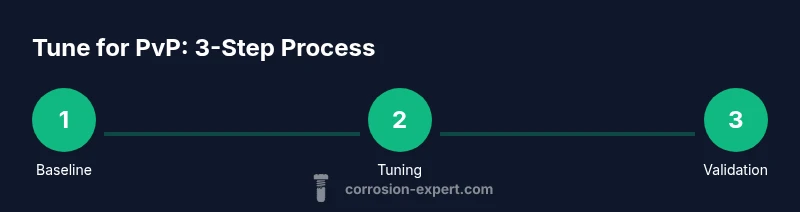
A structured workflow helps ensure your changes stick. Begin with a clear performance goal, apply the smallest plausible changes, then test in a controlled PvP scenario. Keep notes on FPS, latency, and perceived targeting accuracy. Finally, lock in a preset that reliably delivers consistent results across maps and servers. This mindset reduces drift between sessions and helps you build a reproducible setup for future patches.
Common pitfalls and troubleshooting
Common mistakes include over-optimizing visuals at the expense of response time, ignoring input lag from peripherals, and neglecting to benchmark under actual PvP conditions. Always test in a live scenario rather than relying on synthetic benchmarks. If you notice micro-stutter or stuttering during a fight, revisit frame pacing and check background processes. A consistent approach—test, record, compare—yields the most reliable improvements.
How to test changes and measure impact
Create a repeatable test protocol: run a controlled PvP drill with identical equipment, map, and time of day. Measure FPS stability, input lag (roughly by time-to-target acquisition), hit registration consistency, and subjective feel of responsiveness. Use in-game telemetry where available and maintain a simple log to compare before/after states. The most meaningful data is how the changes perform in real fights, not in isolated benchmarks.
Real-world scenarios and cautions for PvP
If you play on a laptop or older desktop, prioritize stability over peak FPS. On a high-end rig, you can push toward higher detail with an eye on whether the extra frames translate to tangible in-game advantages. Some servers have higher tick rates that exacerbate latency; in those cases, keep your settings lean and ensure you don’t spike GPU usage during battles. Also consider your headset or speakers; audio cues often inform timing in PvP, so opt for reliable audio with low latency.
Next steps and building your own preset
Once you’ve found a baseline that feels smooth and responsive, document the exact settings and the test results. Revisit this baseline after patches or driver updates, and repeat the testing cycle. The goal is a repeatable process that yields consistent outcomes across sessions, maps, and server types. With practice, you’ll be able to dial in a personalized rust settings for pvp profile that suits your play style and hardware.
mainTopicQuery":"rust pvp settings"},
toolsMaterialsVersion
Tools & Materials
- PC with capable GPU(A mid-range GPU or better helps sustain stable FPS in PvP combat.)
- 1080p or 1440p monitor with 144Hz+ refresh rate(Higher refresh rates improve perceived responsiveness.)
- Reliable internet connection(Low ping and stable bandwidth improve hit registration.)
- Updated graphics drivers(Keeps performance optimizations and bug fixes current.)
- Quality mouse with adjustable DPI(Precise control aids consistent aim.)
- Optional: external DPI switch or macro hardware(Useful for on-the-fly sensitivity changes, use responsibly.)
Steps
Estimated time: 30-45 minutes
- 1
Baseline assessment
Record your current FPS, input lag, and hit registration in a controlled PvP drill. Note any stutter or noticeable latency when switching weapons or reacting to threats. This establishes your starting point.
Tip: Use a short, repeatable PvP scenario to reduce variability. - 2
Set a performance target
Define a target frame rate and latency that feels smooth in your typical play sessions. A practical target is stable FPS with minimal variance across combat exchanges.
Tip: Aim for a margin of error you can reliably maintain in live matches. - 3
Adjust graphics for FPS-first balance
Tweak textures, shadows, post-processing, and effects to reduce GPU load while maintaining essential combat cues. Keep AA and motion blur off initially.
Tip: Turn off features that do not directly affect aiming cues. - 4
Tune FOV and input sensitivity
Experiment with a middle-ground Field of View that balances peripheral awareness with target acquisition. Calibrate mouse DPI and in-game sensitivity to maintain consistent crosshair movement.
Tip: Document your DPI and sensitivity settings for easy re-application. - 5
Test in live PvP and measure impact
Run a handful of real combat scenarios, noting FPS, latency, and perceived control. Compare with your baseline to quantify gains.
Tip: Consistency beats occasional spikes in performance. - 6
Lock in your preset and maintain
Finalize the settings that gave the best balance between visuals and performance. Create a note with the exact values and re-test after patches or driver updates.
Tip: Schedule quarterly re-tests to adapt to game patches.
Quick Answers
What is the most impactful setting for PvP in Rust?
The most impactful setting is usually the frame rate and latency-related options, like resolution scaling, post-processing, and shadow quality. Prioritize stable FPS over high visual fidelity to improve hit registration in PvP scenarios.
The biggest impact often comes from stabilizing FPS by trimming post-processing and shadows, which helps hit registration in competitive play.
Should I use a wide or narrow FOV for PvP?
A moderate FOV typically offers a balance between peripheral awareness and aim stability. Test around 90–100 degrees and adjust based on comfort and hardware. More FOV can tax the GPU and blur cues if not paired with performance improvements.
Try a middle-ground FOV first, then tweak up or down based on how it affects your aiming and frame rate.
Is motion blur bad for PvP?
Yes, motion blur often hampers precise aiming and increases perceived lag. Disable motion blur during PvP sessions and reintroduce it only for cinematic moments if at all.
Motion blur usually hurts accuracy in PvP, so turn it off for competitive play.
What about high-end vs low-end hardware?
Low-end systems benefit most from aggressive performance tweaks, while high-end rigs can maintain higher visuals with careful testing. Always baseline on your actual hardware.
If you have a strong PC, you can push visuals further, but you should still test for consistency in your PvP drills.
How do I measure improvements objectively?
Use repeatable PvP drills and track FPS, frame time variance, and perceived control. Compare before/after data to confirm improvements rather than relying on feel alone.
Keep a log of FPS and latency during a standard PvP drill to confirm improvements.
Should I disable anti-aliasing for PvP?
Disabling AA can reduce GPU load and improve crispness at distance, which may help aiming. If jagged edges hinder targeting, enable a light AA setting.
Try AA off first, then consider a light setting if jagged edges interfere with accuracy.
Watch Video
Quick Summary
- Prioritize FPS-first tuning for PvP performance
- Test changes in real PvP scenarios, not synthetic benchmarks
- Document settings to enable reproducible results
- Balance is personal—keep a baseline and iterate