Best Rust Setting for FPS: Maximize Rust Performance in 2026
Learn how to configure settings for the best rust setting for fps in Rust. This guide covers in-game tweaks, drivers, launch options, and testing methods for stable, high FPS.


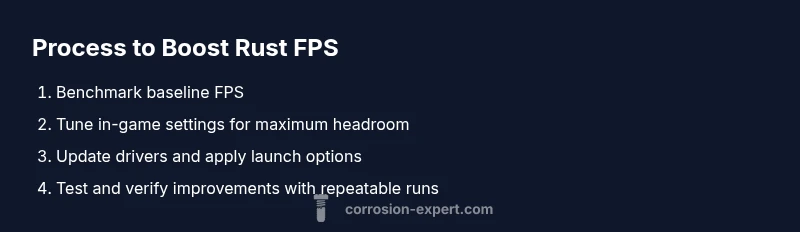
Goal: achieve the best rust setting for fps by balancing visuals and performance in Rust (the game). Start with a baseline FPS check, then tune in-game graphics, update drivers, and apply launch options. You’ll need a modern PC, current GPU drivers, and a stable internet connection. Follow these steps for smoother, higher-frame gameplay.
Why FPS optimization matters for Rust
If you’re chasing the best rust setting for fps in the Rust game, you’re balancing dramatic visuals with smooth, responsive gameplay. Higher FPS reduces input lag, improves aim accuracy, and makes environmental changes feel immediate, which matters in raids or PvP. In practice, most players notice tangible gains by tuning a few key settings rather than chasing ultra-detailed visuals. According to Corrosion Expert, players often overestimate the need for ultra-graphics when hardware is the bottleneck, and the biggest gains come from targeted optimizations rather than brute-force GPU power. The goal is to maximize frame rate headroom without sacrificing essential clarity for combat and navigation. Start by establishing a repeatable baseline, then test iteratively to confirm genuine improvements. Remember that the best rust setting for fps is context-specific and dynamic; your target should be a stable frame rate that feels consistently smooth during intense moments.
Baseline helps you quantify progress. Run the same map segment with identical settings multiple times, and record average FPS, 1% low, and frame-time variance. The more consistent the numbers, the more reliable your tweaks. With a solid baseline, you can distinguish real performance wins from transient frame spikes.
noteTypeInitialsOnly”:
Tools & Materials
- PC or laptop meeting mid-range specs(Ensure your system is capable of running Rust smoothly; aim for a stable baseline before tweaking.)
- Stable internet connection(Used for consistent game updates and online testing.)
- Up-to-date GPU drivers(Download from the GPU vendor’s site (NVIDIA/AMD/Intel).)
- Steam or game launcher(Needed to configure launch options and access settings.)
- FPS counter software or in-game counter(For repeatable benchmarking across sessions.)
- Backup storage or cloud storage(Keep a copy of original configs before edits.)
Steps
Estimated time: 45-75 minutes
- 1
Establish a baseline performance
Run a repeatable map segment with your current settings and record the average FPS, 1% low FPS, and frame time. Do this multiple times to reduce variance. The goal is to know your starting point before any changes.
Tip: Use the same map area, time of day, and server settings for every run. - 2
Update drivers and OS
Install the latest GPU drivers and ensure Windows or your OS is fully updated. Reboot and re-benchmark to confirm changes are ready to interpret.
Tip: Driver updates can deliver meaningful frame-time improvements beyond fancy game tweaks. - 3
Tweak core in-game graphics
Adjust the most impactful settings first: lower shadow quality, reduce draw distance, shut off post-processing, and disable ambient occlusion. Leave textures reasonable to avoid VRAM bottlenecks.
Tip: Make one change at a time and test, so you know which setting caused any change. - 4
Balance resolution and scaling
Set a modest render scale or resolution to improve FPS without sacrificing legibility. If available, enable dynamic resolution to preserve clarity during action moments.
Tip: Avoid drastic drops; small increases in headroom yield bigger perceptible gains. - 5
Apply launch options and config tweaks
Add safe, documented Steam launch options to reduce overhead and tailor resource allocation. Back up your configs before edits and test changes iteratively.
Tip: Use conservative flags first; avoid experimental options that could destabilize your game. - 6
Optimize hardware headroom
Evaluate CPU, RAM, and storage usage. If CPU is a bottleneck, minimize background tasks and consider memory-speed improvements or faster storage. If GPU-bound, scale back more aggressively on post-processing.
Tip: Close non-essential programs during play sessions to keep headroom available. - 7
Verify improvements with retest
Run the same baseline tests after applying tweaks, and compare results. If gains aren’t apparent, revert the last change and run the test again. Document each step to track what worked.
Tip: Consistency in testing is the difference between reliable gains and noise.
Quick Answers
What is the best FPS target for Rust?
There isn’t a universal target. Aim for a stable average FPS with strong 1% lows suitable for your monitor and playstyle. Use your baseline to determine a realistic goal.
Aim for a stable average FPS with good 1% lows based on your setup and monitor.
Do in-game settings always increase FPS?
Not always. Some settings trade visuals for performance; prioritize options with the biggest impact on frame time and headroom.
Some settings improve FPS more than others; focus on the biggest gains.
Should I disable V-Sync permanently?
V-Sync can cap FPS and reduce tearing. Use adaptive sync or off if you want maximum FPS and have no tearing issues.
V-Sync can cap FPS; consider adaptive or turning it off for max FPS.
Will lowering resolution hurt my experience?
Lowering resolution increases FPS but reduces image clarity. Use dynamic resolution or resolution scaling to balance clarity and performance.
Lowering resolution boosts FPS but hurts clarity; use it carefully.
How often should I re-benchmark?
Benchmark after major changes or driver updates. Regular checks help ensure gains are real and not due to variability.
Benchmark after big changes or updates and recheck regularly.
Are launch options worth it for FPS?
Some safe flags can reduce startup overhead and improve perf. Only use documented, stable options for your build.
Launch options can help; pick safe flags and test incrementally.
Watch Video
Quick Summary
- Benchmark baseline FPS before changes
- Prioritize the largest FPS levers first
- Test changes iteratively and measure results
- Keep drivers and OS updated for stability
- Aim for a stable target FPS, not sporadic spikes