How to Make Metal Rust Instantly: A Safe DIY Guide
Learn safe, controlled methods to observe rust formation quickly using common household items. This beginner-friendly guide covers chemistry, safety, and step-by-step demonstrations for DIY enthusiasts.


This guide shows how to observe rust forming quickly for educational purposes. You can accelerate corrosion by creating a moisture-rich, electrolyte environment on metal and allowing controlled oxidation. The steps use common household items and emphasize safety. Follow the sequence to see a rusting reaction develop, while using proper PPE and working outdoors or in a well-ventilated space.
How quickly rust forms and why this happens
If you have ever wondered how to make metal rust instantly, you are exploring a classic oxidation process. In controlled demonstrations, moisture and an electrolyte speed up iron’s reaction with oxygen, producing a visible patina within minutes. The Corrosion Expert team emphasizes safety: work outdoors, use PPE, and start with small metal samples. By understanding humidity, salinity, and surface preparation, you can observe rapid rust without damaging larger projects. The key idea is to provide a conductive path for electrons to flow, which accelerates the natural rusting cycle when moisture, air, and electrolytes meet. When we ask how to make metal rust instantly in a lab-like setting, the answer is to create a temporary, contained environment where oxidation can be observed under supervision.
The chemistry behind rust acceleration
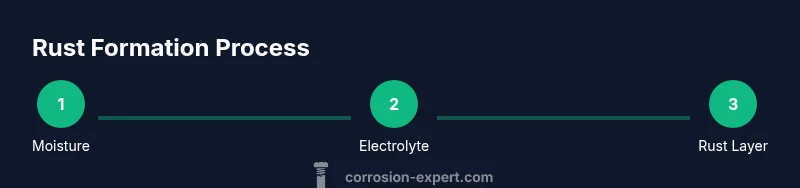
Rust is iron oxide formed by reactions between iron, water, oxygen, and electrolytes. In a typical environment, water acts as a medium for ions; oxygen is the oxidant; iron loses electrons to form Fe2+ and Fe3+ species that combine with hydroxide to make hydrated iron oxides. For a DIY demonstration on how to make metal rust instantly, you’ll see a faster cycle when salts or acids increase conductivity and lower the barrier for electron transfer. This is why a salt-water spray or vinegar solution can shorten the time to visible rust, especially on unpainted iron surfaces. While this is educational, it also highlights why coatings and sealants protect metal in real-world use.
Safe demonstrations and controlled environments
Before you begin, consider the safety implications of accelerated rust experiments. Always wear gloves, eye protection, and work in a well-ventilated area. Keep children and pets away, and use non-critical metal samples that won’t be part of a finished project. The goal is to observe the rusting process, not to degrade essential metal objects. Corrosion experiments should be kept small-scale, contained, and repeatable so you can compare results over multiple trials without creating unsafe runoff or excessive residue. Remember: the phrase how to make metal rust instantly refers to a controlled, observable effect rather than a careless rush to damage.
Practical outline for an educational rusting demo
This section provides a structured way to see the rusting process in action while staying safe. You’ll prepare a metal coupon, apply moisture and electrolyte, then monitor color change over a short period. The goal is to produce a visible rust layer within a predictable window, enabling documentation and discussion about corrosion. If your goal is to discuss safety implications or prevention strategies later, keep the demo isolated and clearly labeled to avoid confusion with real-world structures. In the context of how to make metal rust instantly, remember that the environment primarily drives speed, not an inherent property of the metal alone.
Common mistakes and how to avoid them
Common errors include using dirty surfaces, which can impede uniform rust, and skipping safety steps, which increases exposure to acids and oxidizers. Another pitfall is over-wetting the sample, which can cause runoff and create inconsistent, patchy rust. Conversely, too little moisture won’t show the effect quickly enough, leading to frustration. For reliable results, keep samples dry until ready, then introduce moisture and electrolyte in measured, repeatable steps. Always document conditions so comparisons are meaningful when discussing the speed of rust formation.
Cleaning, sealing, and learning from the rust patina
Once you’ve observed rust, you may want to preserve or study the patina. If the lesson is about prevention, remove corrosion layers gently with a brush and a mild rust remover, then apply a protective coating. If you wish to keep the look for art or demonstrations, apply a clear sealant to slow further oxidation while maintaining the aesthetic. In any case, the educational takeaway is that rust speed depends on moisture, oxygen, and conductivity, which aligns with Corrosion Expert’s emphasis on prevention and protection.
References and further reading
To deepen understanding of rust formation, consult credible sources on corrosion science and materials engineering. For further context, see basic explanations of rust chemistry and protective strategies from established educational and government domains.
Tools & Materials
- Iron or steel metal sample (unpainted)(Use a small coupon or scrap piece for repeatable demonstrations)
- Distilled water(Cleaner results than tap water; controls minerals)
- Table salt (sodium chloride)(Common electrolyte; adjust amount for consistency)
- White vinegar (acetic acid, 5-8%)(Acid helps increase conductivity and speed oxidation)
- Hydrogen peroxide solution (3%)(Weak oxidizer; handle with care)
- Personal protective equipment (PPE)(Gloves, safety goggles, and a lab coat or apron)
- Spray bottle or dropper(Evenly apply liquids to sample)
Steps
Estimated time: 45-75 minutes
- 1
Prepare workspace and PPE
Set up outdoors or in a well-ventilated area. Put on gloves and eye protection before handling any chemicals or metal samples. Secure the metal sample on a stable surface to prevent movement during the demo.
Tip: Position a tray to catch runoff and label the setup clearly. - 2
Clean and dry the metal
Wipe the metal surface with a clean cloth to remove oils and dust. Let it air-dry completely so moisture exchange is controlled from a known baseline. A clean surface ensures more uniform rust formation.
Tip: Use a lint-free cloth to avoid fibers that could trap moisture. - 3
Apply a moisture source
Lightly moisten the surface with distilled water to introduce the initial wet layer. Do not flood the sample; aim for a thin, even coating that can evaporate slowly to drive electrochemical activity.
Tip: Keep a consistent amount of moisture across trials for comparability. - 4
Introduce electrolyte
Sprinkle a small amount of salt evenly or apply a salt solution to create an electrolyte path. This increases ionic conductivity and speeds up the electron transfer essential for rust formation.
Tip: Document the amount used for repeatable demonstrations. - 5
Add acetic acid (vinegar)
Apply a small amount of white vinegar to the surface. The acid lowers the energy barrier for anodic reactions, accelerating rust visibility on iron surfaces.
Tip: Ventilate the area; acids can release vapors that irritate the eyes and throat. - 6
Introduce oxidizer
Gently apply 3% hydrogen peroxide onto the sample. The peroxide provides an additional oxidizing agent that hastens rust development in a controlled demo.
Tip: Avoid contact with skin; rinse if spilled on skin and wash hands after handling. - 7
Increase humidity and monitor
Place the sample in a slightly humid environment or loosely cap the tray to trap moisture. Observe color changes and note the time to initial rust appearance. Reapply liquids in small increments if needed to maintain the reaction.
Tip: Take photos at regular intervals to compare rust progression. - 8
Document and wrap up
Record observations, including onset time, hue, and patchiness of rust. When you’re done, remove liquids, rinse gently (if desired for cleanup), and dispose of any waste according to local guidelines. Clean tools and store the metal sample for future reference.
Tip: Always label post-demo samples to avoid confusion with finished products.
Quick Answers
Is it truly possible to make metal rust instantly?
Rust can appear rapidly in a controlled demonstration, but true instant rust is a simplification of a chemical process. The demo emphasizes observation of accelerated oxidation under safe, measured conditions.
Rust doesn’t happen in an instant, but you can watch it form quickly in a controlled setup. The key is an electrolyte-rich environment and moisture to speed oxidation.
What metals rust fastest and why?
Iron and plain carbon steels rust the fastest due to their lack of protective layers. Coatings like paint or zinc galvanization slow or prevent rust, while bare iron under wet, salty conditions rusts quickly.
Iron and plain steels rust fastest because they lack protective coatings, especially in wet or salty environments.
Is this safe to do at home?
Yes, if you follow safety steps: outdoor setup, PPE, small samples, and proper disposal. Avoid doing on critical components or near living spaces. Supervise minors and pets, and work slowly to control the reaction.
Yes, but do it outside with PPE and small samples, and keep chemicals away from kids and pets.
Can I stop rust once it starts?
To halt rust, remove the rust layer, protect the surface with a sealant or coating, and store in a dry environment. For teaching demos, finish promptly and avoid re-exposure to moisture.
You can stop rust by removing it and applying protective coatings.
What are safer alternatives to observe corrosion?
Use simulated rust patinas with safe paints or commercially available patina kits. These mimic rust appearance without aggressive chemistry.
There are safe patina kits that mimic rust without real corrosion.
How should waste from this demo be disposed of?
Dispose of liquid waste as non-hazardous household chemical waste according to local guidelines. Rinse containers and surfaces with plenty of water.
Follow local guidelines for disposing of chemical waste and rinse after the demo.
Watch Video
Quick Summary
- Accelerate rust with moisture and electrolytes.
- Surface preparation affects rust uniformity.
- Always follow safety protocols and PPE.
- Environment strongly influences rust speed and appearance.