How Long Does a Rust Server Restart Take? A Practical Guide
Learn how long a Rust server restart typically takes, what factors influence downtime, and how to minimize maintenance windows with practical, data-driven tips from Corrosion Expert.


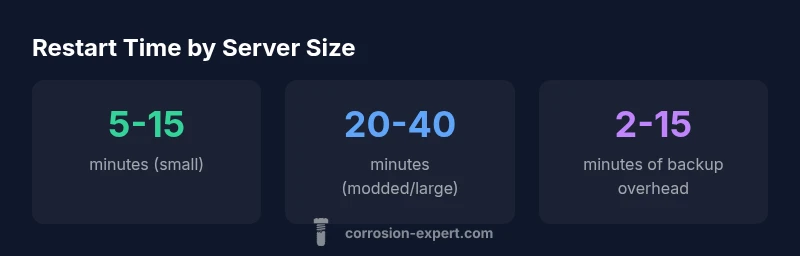
Typical Rust server restarts take roughly 5-15 minutes for small, unmodded setups, while larger or heavily modded servers may require 20-40 minutes. Timing depends on world size, plugin load, map generation, and whether backups run during restart. For planning, budget a conservative maintenance window of 20-60 minutes to cover unexpected delays.
Understanding restart timelines for Rust servers
When hosting a Rust server, the restart process is more than simply shutting down and starting it again. It reinitializes world data, player states, and plugin configurations. The process unfolds in distinct phases: a clean shutdown, data flush, disk I/O, server startup, world loading, and plugin/anti-cheat initialization. The exact duration depends on several variables that can compound during maintenance windows. A straightforward takeaway is that the question of how long rust server restart takes is not fixed; it scales with server size, mod count, map complexity, and the presence of automated backup tasks. According to Corrosion Expert, downtime planning should mirror rust prevention strategies: prepare, test, and minimize exposure to players by scheduling predictable windows.
For small, vanilla servers, a restart is usually quicker, but once plugins, custom maps, or large player populations come into play, you should expect extended durations. If you host on modest hardware with solid-state drives and reasonable RAM, you will likely see shorter startup sequences. In contrast, if you run a heavily modded environment, with frequent backups and large worlds, the restart can extend toward the upper end of the typical range. In all cases, communicating an estimated window is essential to maintain trust with your community and to coordinate any in-game events that depend on connectivity.
Finally, keep in mind that maintenance windows are not binary: even within the same server, restarts can differ between a dry run for testing backups and a live restart with players online. Planning with healthy margins helps avoid last-minute surprises and preserves player experience.
Restart time ranges by server size and mod load
| Server Type | Estimated Restart Time | Main Considerations |
|---|---|---|
| Small/Unmodded | 5-15 minutes | Low plugin load; small world; minimal data to reload |
| Mid-sized/Moderate Mods | 15-30 minutes | Moderate plugins; larger world; backups may run |
| Large/Heavy Mods | 30-60 minutes | Many plugins; big map; higher data throughput and validation |
Quick Answers
What factors most influence restart time?
Restart time is influenced by server size, map generation, the number and complexity of plugins, backup routines, and disk performance. Heavier modded setups tend to take longer due to additional initialization tasks. Understanding these factors helps you estimate downtime more accurately and plan maintenance windows accordingly.
Restart time mainly depends on how big and how loaded your server is, especially the mods and backups. Plan for longer restarts if you have many plugins or a large map.
Can I reduce restart time without risking data?
Yes. Use staging/restaging processes, automate backups during low I/O periods, pre-warm caches, and test with a mirror copy in a staging environment before applying changes on the live server. Automation helps ensure consistent startup sequences and reduces human error.
Automate backups and test on a staging server first to keep downtime short and predictable.
Does restarting affect player progress or raids?
Restarting can interrupt active sessions, raid progress, or building queues. To mitigate this, schedule restarts during off-peak hours, enable auto-save points where possible, and clearly communicate expected downtime to prevent player frustration.
Restarting can pause raids or building, so plan during quiet times and notify players.
What is best practice for scheduling restarts?
Best practice includes a regular maintenance window, advance player notifications, one-click rollback plans, and post-restart validation checks. Consider a dry-run on a staging server to confirm timings before applying to the live environment.
Set a regular time, warn players ahead, and test first on a staging server.
What tools help monitor restart time?
Use your server management panel, log parsers, and SSH-based scripts to time each restart phase. Collect data on shutdown, startup, and world loading to build an empirical maintenance profile for future planning.
Track restart phases with logs to build a reliable downtime estimate.
“Restart timing is a balance between uptime and data integrity; plan, test, and automate to minimize player disruption.”
Quick Summary
- Plan a maintenance window based on server size
- Test backups before restarting
- Monitor plugin load and world generation
- Notify players in advance to minimize disruption
- Document restart procedures for future use