Rust vs DayZ: Practical Differences for DIYers and Gamers
Explore the difference between rust (oxidation) and DayZ (a survival game) with an analytical, side-by-side look at risk, maintenance, and strategy. Learn how each domain treats decay, resources, and resilience.


The difference between rust and DayZ lies in their nature and purpose: rust is a natural chemical process that corrodes metals, while DayZ is a survival video game. This quick comparison highlights how each domain approaches risk, strategy, and upkeep.
What rust actually is
Rust is a chemical process—oxidation—where iron or steel reacts with oxygen in the presence of moisture. Over time, and under the right conditions (humidity, salt exposure, temperature fluctuations), a protective layer of iron oxide forms, progressing from surface discoloration to flaky, structurally weakened metal. Homeowners often encounter rust on outdoor tools, fences, and vehicles, and the key to mitigation is understanding the environmental triggers. Basic prevention practices include keeping metal dry, applying protective coatings like paint or rust inhibitors, and performing routine maintenance to remove early signs of corrosion before it penetrates deeper layers. Practical rust knowledge emphasizes long-term strategies: humidity control, periodic inspection, and choosing corrosion-resistant alloys or protective finishes for high-risk areas. In everyday terms, rust is a slow chemical process that rewards preventive care more than reactive fixes.
What DayZ is
DayZ is a survival-focused video game that drops players into a post-outbreak world where they must scavenge resources, manage hunger and stamina, and interact with other players. The game emphasizes planning, shelter, and risk assessment in a dynamic environment where threats include environment, wildlife, and multiplayer opponents. Unlike rust, DayZ’s “maintenance” revolves around inventory management, base-building, and strategic decisions about when to push forward or retreat. Players learn to optimize routes, prioritize essential supplies, and balance short-term gains with long-term survival. Understanding DayZ’s mechanics helps illustrate how virtual worlds model risk, reward, and resilience in a condensed, game-like cycle.
Core differences: domain, goals, and risk profiles
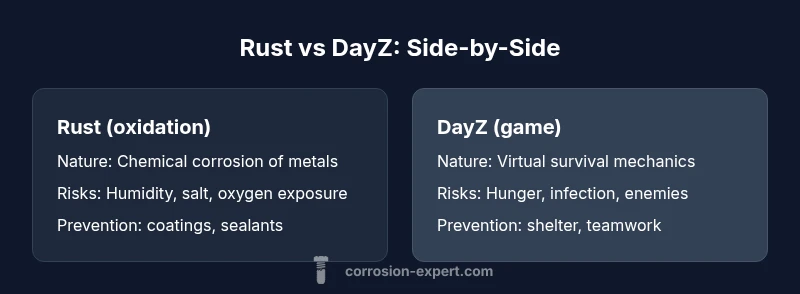
The difference between rust and DayZ becomes clearest when you map domain, goals, and risk profiles side by side. Rust (oxidation) is a real-world chemical process driven by environmental factors and material properties, with the primary objective of delaying deterioration and preserving structural integrity. DayZ is a synthetic system designed for entertainment and challenge, where the goal is to maximize survivability through smart decision-making, scavenging, and social interaction. The risks are fundamentally different: corrosion risks are gradual and predictable under known conditions; gameplay risks are immediate, variable, and influenced by player behavior and game updates. This contrast matters for audiences who care about real-world durability versus virtual strategy. The difference between rust and dayz is not merely semantic; it reflects distinct domains with separate methods, tools, and success metrics.
Practical implications for homeowners and gamers
For homeowners dealing with rust, the practical takeaway is to build a prevention plan rooted in materials science: select rust-resistant coatings, control moisture, and schedule regular inspections. For gamers, the takeaway is to study DayZ’s systems—loot distribution, spawn timers, and base durability—to optimize playstyle and team coordination. Yet there is value in cross-domain thinking: conceptually, both domains reward proactive planning and scenario awareness. If you can translate a maintenance mindset from metal preservation into your in-game strategy, you’ll build resilience both in the physical world and in virtual environments. The key is to keep the two domains distinct in practice while borrowing universal lessons about risk management, resource prioritization, and long-term planning.
How to study both domains responsibly
Approach rust and DayZ with clearly defined goals and audiences in mind. For rust, document environmental conditions and test protective measures in small, controlled experiments before applying them to larger projects. For DayZ, observe how changes in patches or servers alter survival dynamics and adjust your in-game strategies accordingly. Keeping notes, tracking outcomes, and applying a learning loop will help you extract transferable insights without conflating real-world maintenance with gaming mechanics. The overarching lesson is that disciplined observation and iterative improvement translate across disciplines, helping you make smarter decisions wherever rust or DayZ intersects with your interests.
Comparison
| Feature | Rust (oxidation) | DayZ (video game) |
|---|---|---|
| Nature | Chemical corrosion of metals | Virtual survival simulation with player-driven dynamics |
| Primary risks | Humidity, salt, oxygen exposure, material quality | Hunger, cold, infection, enemies, theft or betrayal |
| Maintenance approach | Coatings, sealants, moisture control, periodic inspection | Inventory management, shelter building, resource planning |
| Typical materials involved | Iron, steel, metal alloys | Characters, weapons, vehicles, buildings in-game assets |
| Audience focus | Homeowners, DIYers, maintenance professionals | Gamers, streamers, competitive players |
The Good
- Clarifies real-world vs virtual domains for better decision making
- Encourages cross-domain learning about risk management and upkeep
- Provides a structured framework to compare unrelated topics
Cons
- Risk of confusing real-world maintenance with gaming content
- DayZ content may feel irrelevant to readers focused on rust prevention
- Balancing depth for both audiences can be challenging
Rust vs DayZ: clearer distinctions between real-world corrosion and virtual survival emerge from a disciplined, cross-domain comparison
Rust is a real-world chemical process driven by environment and material properties, while DayZ is a game that simulates survival challenges. The article recommends treating them as separate domains, applying general risk-management principles to both where appropriate, and avoiding conflating in-game decisions with real-life maintenance practices.
Quick Answers
What is rust in practical terms for homeowners?
Rust is the chemical oxidation of iron and its alloys caused by moisture and oxygen. In real settings, prevention focuses on reducing exposure, applying protective coatings, and repairing affected areas early to slow progression.
Rust is basically iron meeting oxygen with moisture—that's why keeping things dry and coated matters.
What is DayZ and how does it influence player decisions?
DayZ is a survival video game where players manage resources, weather, and threats. Decisions hinge on scavenging efficiency, shelter quality, and risk assessment in a dynamic, multiplayer world.
DayZ is a survival game about careful planning and smart choices under pressure.
Can knowledge about rust help me play DayZ better?
There is some transferable thinking, like risk assessment and long-term planning, but real-world rust and in-game decay operate under different rules. Use general maintenance mindset, not specific rust tactics, in DayZ.
You can borrow the idea of planning ahead, but don’t overextend real rust rules into the game.
Why is distinguishing rust vs DayZ important for readers?
Understanding the difference helps readers avoid applying one domain’s rules to the other, reducing confusion and improving decision-making in both home maintenance and gaming contexts.
Knowing the difference keeps real-world care grounded and game strategies practical.
Are there overlap strategies between rust prevention and DayZ survival?
Yes, both benefit from proactive resource management, risk assessment, and modular planning. However, the specifics—materials, conditions, and mechanics—differ, so apply concepts contextually.
Both domains reward planning and smart resource use, but apply them in their own context.
Quick Summary
- Define rust as a chemical corrosion process and DayZ as a game with survival mechanics
- Use cross-domain thinking to improve risk assessment and planning in both domains
- Keep real-world rust prevention methods separate from gaming strategies
- Apply disciplined observation and iteration to learn transferable maintenance lessons