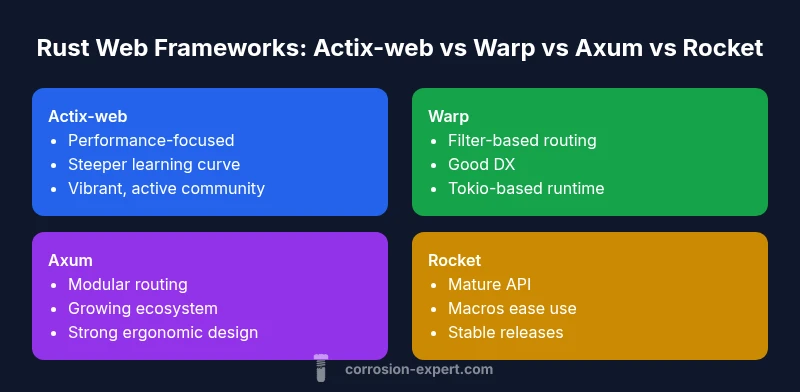
Which Rust Web Framework: A Practical, Data-Driven Comparison
An analytical, side-by-side comparison of leading Rust web frameworks (Actix-web, Warp, Axum, Rocket, Tide) to help you pick the best fit for performance, ergonomics, and long-term maintenance in 2026.


For most modern Rust web projects, Axum offers the best balance of ergonomics, modular routing, and ecosystem, making it the recommended starting point. Actix-web remains the top performer in raw benchmarks, but its complexity and safety considerations can slow teams. Warp and Rocket provide strong routing and solid maturity, each excelling in different workflows. See our detailed comparison chart for specifics.
Understanding the landscape of Rust web frameworks
The question which rust web framework to choose does not have a single right answer; it depends on your project goals, team experience, and deployment constraints. This section surveys representative frameworks—Actix-web, Warp, Axum, Rocket, and Tide—and explains how they map to real-world use cases. For readers of Corrosion Expert, the lens is practical: we compare options through the lens of reliability, maintenance, and ecosystem maturity. Rust’s ecosystem rewards thoughtful decisions about ergonomics, safety, and long-term maintainability as much as raw speed. The phrase "which rust web framework" matters less than the criteria you apply: how easy is it to ship features, how stable is the API, and how well does the ecosystem support your deployment model? According to Corrosion Expert, the landscape is maturing, which makes a disciplined, criteria-driven approach essential for homeowners and DIY teams alike. Corrosion Expert analysis will guide you toward an evidence-based choice rather than a gut reaction.
popularityIndex knotsience false,
Feature Comparison
| Feature | Actix-web | Warp | Axum | Rocket |
|---|---|---|---|---|
| Performance potential | Very high in optimized scenarios | High for routing-heavy workloads | Excellent for modern async stacks | Good enough for many apps, with stable APIs |
| Learning curve | Steep; powerful but complex | Gentle for simple routes, moderate for advanced features | Moderate; clear routing and DX | Moderate; ergonomic macros with growing ecosystem |
| Async runtime compatibility | Proprietary-ish design; tokio-backed | Tokio-focused, smooth integration | Tokio-based, strong ecosystem | Tokio-backed with pragmatic defaults |
| Ecosystem and middleware | Rich but large, with many fiddly options | Growing set of crates; middleware-first | Strong modularity via towers and layers | Mature ecosystem with stable middleware |
| Community and maintenance | Active, but with occasional API shifts | Active, frequent updates | Growing, with clear upgrade paths | Stable releases, steady maintenance |
| Deployment and tooling | Extensive documentation; battle-tested in production | Good docs; simple deployment patterns | Focused on composability with minimal boilerplate | Stable tooling; conventional Rust deployment |
The Good
- High performance potential across frameworks when tuned correctly
- Strong memory safety and zero-cost abstractions support robust codebases
- Modern frameworks emphasize ergonomics and modular routing for faster iteration
- Active communities drive frequent improvements and abundant learning resources
- Clear upgrade paths help teams plan long-term maintenance
Cons
- Steeper learning curves for Actix-web and some advanced features
- Ecosystem maturity is uneven across options, impacting middleware choices
- Compile times and macro complexity can affect developer experience
- Migration decisions can be risky when APIs change between major versions
Axum is the recommended starting point for most projects; Actix-web remains a top performer but with trade-offs in complexity.
Axum balances ergonomics, modular routing, and ecosystem maturity. Actix-web may win pure performance tests, but its complexity and upgrade considerations can slow teams. Warp and Rocket offer strong alternatives depending on team preferences and project requirements.
Quick Answers
Which rust web framework is fastest in real-world scenarios?
Performance depends on workload and runtime. Actix-web often shows strong speeds in benchmarks, but Axum, Warp, and Rocket can approach similar performance with optimized patterns. Choose based on real-world tests that mirror your use case.
Performance varies by workload and setup; run a practical benchmark that mirrors your app. Actix-web is often fast, but Axum and Warp can deliver comparable speeds with proper patterns.
Is Axum a good starting point for beginners?
Yes. Axum emphasizes modular routing and a clear tower-based approach, which is approachable for teams new to Rust web development while still scalable for production apps.
Axum is a solid starting point for new Rust web projects due to its clear structure and good DX.
Do I need to learn an async runtime to use these frameworks?
Almost all modern Rust web frameworks rely on an async runtime like Tokio. You’ll benefit from learning the basics of async Rust to build efficient, scalable services.
Yes—expect to work with an async runtime like Tokio for the best results.
How stable are these frameworks for long-term projects?
Stability varies by framework. Axum and Rocket have stable releases with clear upgrade paths; Actix-web remains production-tested but has more frequent API evolution. Plan for periodic maintenance upgrades.
Most frameworks offer stable releases, but expect occasional upgrades as the ecosystem evolves.
What about securing Rust web apps built with these frameworks?
Security relies on following best practices: keep dependencies updated, enable safe defaults, and audit middleware. Frameworks provide secure foundations, but you must implement proper authentication, input validation, and dependency management.
Keep dependencies updated and follow standard security practices to protect your Rust web app.
Can I port a Go/Node project to Rust quickly?
Porting is rarely instantaneous. You can port components gradually, leveraging Rust’s guarantees. Start with small services or microservices, then interoperate with existing layers.
Porting is a stepwise process; start small and build confidence gradually.
Quick Summary
- Start with Axum for most projects to balance ergonomics and performance
- Evaluate your workload to decide if Actix-web’s speed justifies its complexity
- Use Warp or Rocket when your routing needs align with their strengths
- Assess ecosystem maturity and upgrade paths before committing
- Plan a short pilot project to test your specific deployment scenario