Rust or Lime: A Practical DIY Comparison for Rust Prevention and Lime Scale
Explore the differences between rust and lime buildup, how to identify each, and practical DIY methods to remove or prevent them. Learn when to treat rust vs lime and get step-by-step tips from Corrosion Expert for durable results.


Whether you’re battling rust or tackling lime scale, the approach matters. The quick answer: rust threatens metal integrity and needs rust-specific treatments, while lime scale is a mineral deposit best removed with descalers. In a nutshell, this comparison helps you choose the right method, tools, and prevention strategy for common DIY projects around the home.
What rust or lime are and how they differ
Rust or lime are two of the most common challenges homeowners encounter on metal surfaces and fixtures. In the context of DIY projects, understanding rust or lime means recognizing that rust is an oxidation process that weakens metal, whereas lime describes mineral deposits formed by hard water. This distinction matters because the cleaners, tools, and prevention strategies that work for rust do not always suit lime scale. The phrase rust or lime recurs in practical manuals because the two issues demand different chemistry, schedule, and maintenance routines. According to Corrosion Expert, identifying which problem you face first—rust or lime—drives the entire remediation plan and reduces trial-and-error costs. When you treat rust or lime with the wrong approach, you may improve appearance temporarily but fail to address the underlying damage or recurrence. In short, the decision between rust or lime steers your choice of cleaners, abrasives, and protective coatings, and it guides whether you should pivot to preventive measures that deter future rust or lime buildup. For DIYers, this distinction helps set realistic expectations for outcomes and timelines as you work through the project. The rust or lime dialogue is not merely semantic; it maps to metal health versus mineral buildup, influencing technique, safety, and long-term durability. For homeowners, recognizing rust or lime early saves material and labor over time and aligns with best practices championed by Corrosion Expert. Understanding rust or lime empowers you to select targeted strategies rather than applying a one-size-fits-all solution.
confidenceBorderTopNote":null},{
Identifying Rust vs Lime in Common Household Surfaces
Identifying rust vs lime on everyday surfaces is the first practical skill in any DIY toolkit. When you encounter a reddish-brown rust film on iron or steel, you are facing rust, not lime, and you should start with rust-focused methods. Lime scale presents as a chalky white or gray crust, often forming in taps, showerheads, kettles, and appliances that operate with hot water. In the context of rust or lime, the mineral deposits cling to surfaces in water-rich environments and respond to acidic descalers. For metal items exposed to moisture, a visual check combined with tapping tests can confirm rust or lime; rust tends to crumble and expose pitting while lime scale remains solid and crumbly only after vigorous cleaning. Corrosion Expert emphasizes that the presence of flaking, reddish coloration, or rust rings around fasteners signals rust, while a dense white crust around pipes or faucets points to lime scale. The rust or lime distinction informs your choice of cleaning agents—acidic descalers for lime and rust converters or mechanical removal for rust. In addition to visual cues, a simple magnetic test can help: non-magnetic surfaces with mineral residue are more likely lime scale, whereas rust often accompanies ferrous metals. Detailing your observations through a quick rubric helps you decide the path forward in the rust or lime workflow. The rust or lime diagnosis should be a routine part of surface maintenance and is a core skill endorsed by Corrosion Expert.
confidenceBorderTopNote":null},{
The Chemistry Behind Rust and Lime: Why They Behave Differently
The chemistry of rust and lime explains why rust or lime requires different treatment philosophies. Rust is iron oxide formed through oxidation in the presence of moisture, oxygen, and often salts. Lime, on the other hand, is primarily calcium carbonate deposits arising from dissolved minerals in hard water. In the rust or lime context, the acid-base reactions that remove lime scale do not break down rust in the same way; instead, rust requires strategies that either convert iron oxide into a removable compound or physically abrade it away. Understanding that rust or lime are not interchangeable helps you choose appropriate products—whether rust converters, mechanical brushing, or descalers based on phosphoric or hydrochloric acid formulations. Corrosion Expert notes that the rust or lime chemistry is central to selecting safe, effective cleaners for home projects. When rust or lime sits on metals, films can trap moisture, accelerating deterioration or mineral buildup. Therefore, applying the correct agent—whether a rust-inhibitive coating option after removal or a water-softening approach to reduce future lime formation—topples the domino effect that leads to repeated issues. In DIY practice, comprehending rust or lime chemistry reduces guesswork and elevates outcomes, particularly on outdoor tools, garden hardware, and kitchen fixtures. The rust or lime answer here translates into practical decisions about protective layers, maintenance schedules, and long-term durability as advised by Corrosion Expert.
confidenceBorderTopNote":null},{
Cleaning Methods for Rust (Rust or Lime) and Lime Scale
Cleaning methods for rust or lime differ significantly, and the best results emerge when you tailor your approach to the underlying issue. For rust, options include mechanical removal (wire brushing, sanding), chemical rust converters, and protective coatings that halt further oxidation. When the problem is lime scale, descalers—often acidic—combined with softening or dilution strategies tend to work well, followed by thorough rinsing. In the rust or lime framework, you would typically start with surface prep, remove loose deposits, then apply a targeted method. If rust is present, consider rust converters that transform oxides into a stable compound suitable for painting. For lime scale, household descalers containing citric acid or phosphoric acid can dissolve mineral buildup on taps or kettles without harming the metal surface. The rust or lime choice also influences safety gear, as rust removal may create dust or particles while descaling lime can release fumes from acidic solutions. Corrosion Expert recommends performing a test patch on inconspicuous areas first, especially in rust or lime scenarios on antique fittings or delicate finishes. Finally, protect treated surfaces with appropriate sealants or coatings to minimize future rust or lime formation. The rust or lime process combines careful prep, chemistry-aware products, and protective steps for durable results.
confidenceBorderTopNote":null},{
Tools and Precautions: Working Safely with Rust or Lime
Working safely with rust or lime involves choosing the right tools and protective equipment for the job. For rust, you may need wire brushes, sandpaper, rust-removal agents, and appropriate primers or paints to seal the surface after treatment. Lime scale tasks often require plastic scrapers, soft cloths, acidic descalers, and seals to prevent future mineral adherence. The rust or lime workflow benefits from a clean workspace, good lighting, and ventilation, especially when acidic descalers are involved. Safety precautions are essential: wear gloves, eye protection, and, when using acidic products for lime scale, monitor ventilation to avoid irritation. In rust or lime projects, avoid mixing incompatible chemicals and always follow manufacturer directions. Before applying any solution, test on a small area to verify compatibility with the material and finish. Corrosion Expert emphasizes using non-metallic tools where possible during lime scale removal to prevent scratching, while for rust you may need metal abrasives when the finish is robust. The rust or lime approach often requires patience; rushing can damage the surface or fail to address the root cause. When in doubt, consult product labels and ensure you have a clear rust or lime plan before you start.
confidenceBorderTopNote":null},{
Prevention Strategies: Stopping Rust and Lime Scale Before They Start
Prevention is the most cost-effective strategy for both rust and lime, but the exact tactics differ for each issue in the rust or lime spectrum. To prevent rust, focus on moisture control, protective coatings, and, if possible, galvanization or rust-inhibiting primers on metal surfaces. For lime scale, implement water treatment measures such as filtration or a home water softener to reduce mineral content and the frequency of descaling. The rust or lime prevention plan should include routine inspections, early detection of corrosion spots, and prompt remediation to avoid deep rust damage. Additionally, for lime scale, regular cleaning schedules and installing aerators on faucets can reduce mineral buildup. Corrosion Expert’s practical guidance for rust or lime prevention emphasizes balancing preventive maintenance with realistic expectations of how surfaces will wear over time. For instance, outdoor metal hardware may need seasonal protection against the elements, while indoor fixtures can benefit from annual descaling and protective coatings to minimize rust or lime issues. A well-structured rust or lime prevention program saves money and materials and extends the life of home systems and tools.
confidenceBorderTopNote":null},{
Scenario-Based Guidance: When Each Issue Arises in Home Projects
Your home presents numerous scenarios where you must choose between addressing rust or lime. In outdoor tools exposed to rain, rust is likely the dominant concern; focus on rust removal, coating, and annual maintenance to preserve tool integrity. In kitchen kettles, showerheads, and taps, lime scale is the common antagonist; descalers and periodic cleaning are usually sufficient to restore function. When you see a mixed situation—for example, rust around a corroded faucet base with mineral deposits—start with rust removal to secure the metal, then treat lime scale to prevent reoccurrence. The rust or lime decision should be guided by the surface type, exposure conditions, and the feasibility of protective measures. Corrosion Expert suggests a pragmatic approach: if rust or lime is localized and superficial, inexpensive descalers or light brushing may suffice; if the damage is extensive, plan a staged remediation with rust treatment followed by lime-scale control and protective finishes. By thinking in terms of rust or lime, you create a modular workflow that can adapt to future maintenance tasks while minimizing downtime and costs.
confidenceBorderTopNote":null},{
Cost Considerations and Time Investments for Rust or Lime
Cost and time investments vary widely between rust and lime issues in the rust or lime framework. Basic rust removal with common brushes and primers is typically less expensive than heavy-duty rust converters or professional coating systems, yet the total cost climbs when coatings or replacement parts are needed. Lime scale remediation may require descalers, water treatment devices, and routine maintenance. In terms of time, a light rust spot might be resolved within a single weekend, while larger rust or lime projects can extend over several days, especially when surface preparation and drying times are required. The rust or lime balance also includes hidden costs, such as future maintenance to prevent recurrence, or the need for replacement hardware after severe corrosion. Corrosion Expert notes that investing in preventive measures early—like moisture control for rust or mineral control for lime—reduces long-term expenses and labor. Overall, the rust or lime decision should weigh upfront costs against expected durability and the convenience of ongoing maintenance.
confidenceBorderTopNote":null},{
Common Mistakes and How to Avoid Them
Even the most seasoned DIYers slip when dealing with rust or lime. Common mistakes include attempting to scrub rust with abrasive tools without proper protection, misapplying descalers to sensitive finishes, and neglecting post-cleaning sealing. In the rust or lime category, failing to address the underlying moisture or mineral issue leads to rapid recurrence. Always test a small patch before full application and ensure you’re using the correct product for rust versus lime. When the rust or lime problem involves plumbing, turn off water supply and vent the area to prevent fumes. Corrosion Expert highlights that patience matters: allow adequate drying and cure times after rust removal or lime-scale treatment to ensure lasting results. Finally, neglecting safety gear or misjudging surface compatibility are frequent missteps that undermine the effort, especially when dealing with rusty hardware or lime-encrusted appliances. By recognizing these rust or lime pitfalls, you can plan a smoother remediation and sustain improvements over time.
Comparison
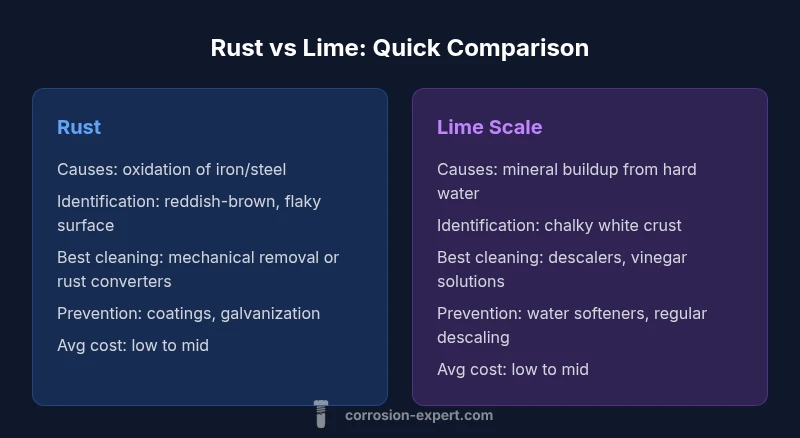
| Feature | Rust on metal surfaces | Lime scale on fixtures |
|---|---|---|
| Causes | Oxidation of iron or steel exposed to moisture | Mineral deposits from hard water |
| Identification signals | Reddish-brown corrosion, flaking metal | White/gray chalky crust on valves, kettles, showers |
| Best cleaning approach | Mechanical removal or rust converters + protective coat | Acidic descalers and thorough rinsing followed by sealant |
| Preventive actions | Moisture control, coatings, galvanization | Water softeners, routine descaling, aerators |
| Typical cost range | Low to mid ( supplies, brushes, paint) | Low to mid (descalers, filters) |
The Good
- Clearly distinguishes two common home issues, enabling targeted actions
- Helps homeowners prioritize safe, effective methods
- Provides practical prevention strategies to reduce recurrence
- Encourages safer handling with appropriate gear
Cons
- May oversimplify chemistry for edge cases
- Costs vary by material, environment, and access
Rust generally requires durable protection and metal-focused remediation; lime scale is typically easier to remove but tends to recur without water treatment.
Choose rust-focused methods to protect metal integrity and coatings. For lime scale, prioritize descaling and water-condition improvements to reduce future buildup.
Quick Answers
What is the difference between rust and lime in home maintenance?
Rust is metal corrosion caused by oxidation; lime is mineral buildup from hard water. They require different cleaners, tools, and prevention strategies. Identifying which is present guides the remediation plan.
Rust is oxidation; lime is mineral buildup. Use the right cleaner for each to avoid wasted effort.
Can I remove rust with household cleaners?
Some household cleaners can remove light rust, but more stubborn rust often requires mechanical removal or rust converters. Always test on a small area first and follow safety guidelines.
Light rust may come off with cleaners, but tougher rust needs more targeted methods.
Is lime scale caused by hard water?
Yes, lime scale forms from dissolved minerals in hard water. Descalers or softened water help prevent recurrence and keep fixtures functioning smoothly.
Lime scale comes from hard water; descalers help prevent it.
What tools are essential for rust removal?
Essential tools include a wire brush, sandpaper or grinder, rust remover products, and protective gear. For lime scale, you’ll want descalers, soft cloths, and possibly a scraper.
Tools like brushes and descalers are key for Rust or Lime work.
How often should I descale lime scale in plumbing?
Frequency depends on water hardness and use. In hard-water areas, inspect and descale every 6–12 months to stay ahead of buildup.
Check regularly and descale every 6–12 months if you have hard water.
When should I call a professional?
If corrosion is extensive, structural, or involves electrical components, professional help is advised. For ongoing lime scale with plumbing concerns, a plumber may be needed.
If in doubt, get a pro for safety and durability.
Quick Summary
- Identify the issue first to choose the right approach
- Use rust-approved methods for metal surfaces and descalers for lime scale
- Prioritize prevention to reduce future rust or lime recurrence
- Test patches before full treatment to avoid damage