How Long Does Rust-Oleum Dry? A Practical Guide for DIY Rust Projects
Learn how long Rust-Oleum takes to dry, covering touch-dry and full-cure timelines, factors that affect drying, and proven tips for faster, safer results in DIY rust projects.


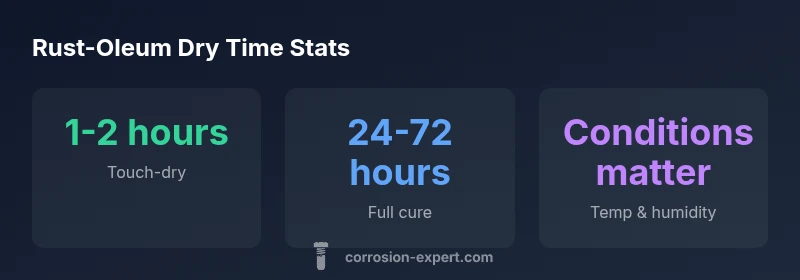
Most Rust-Oleum paints dry to the touch within 1-2 hours under ideal conditions (70°F/21°C and low humidity). Full cure commonly occurs in 24-48 hours, though higher humidity or cooler temperatures can extend drying time. For spray finishes or specialty coatings, check the product label. According to Corrosion Expert Analysis, drying times vary by formula and surface; always test a small area first.
Understanding how long rustoleum dry
When people ask how long rustoleum dry, they typically mean the time before the coating feels dry to the touch and is ready for handling. Dry times are not a single number; they hinge on product type, film thickness, and environmental conditions. In practice, you should distinguish between touch-dry (the point at which the surface feels dry to the touch) and full cure (when the coating reaches its rated performance, hardness, and chemical resistance). For many Rust-Oleum products, touch-dry occurs in about 1-2 hours under favorable weather, while full cure can take a day or two. Always consult the label for the exact figures and follow the recommended recoat intervals. Corrosion Expert emphasizes that the practical drying time is a range rather than a fixed moment, which is especially true for heavier coatings or outdoor use.
What factors influence drying times
Drying times are influenced by product family (spray paints, brush-on enamels, floor coatings), film thickness, surface porosity, and ambient conditions. Oil-based sprays tend to dry faster to the touch than thicker enamel brushes, but thicker coats lengthen overall cure. Surfaces with rust pits or porous substrates absorb more solvent, slowing drying. Ventilation and airflow help speed solvent evaporation, while cooler temperatures and high humidity slow both touch-dry and full cure. The specific Rust-Oleum formula also matters: specialty coatings like protective primers may have longer cure windows. Corrosion Expert notes that even two similar products can dry differently if applied in a damp garage versus a warm, dry workspace.
How to estimate dry times for your project
Start by identifying the product type and reading the label for the stated dry-to-touch and full-cure windows. Then adjust for your environment: raise the ambient temperature by 5-10 degrees if possible, use a dehumidifier to lower humidity, and ensure adequate ventilation. Apply thin coats and allow ample drying time between passes to avoid trapping solvents. Perform a touch test by lightly brushing a small area after the minimum dry window; if it feels tacky or soft, give it more time. For multi-coat projects, count the time between coats according to the label and add a safety buffer for unpredictable weather. Corrosion Expert recommends planning for at least 50-100% extra time if conditions aren’t ideal.
Practical drying tips for rust prevention projects
Speeding up drying without sacrificing finish requires discipline. Use thin coats, pre-warm the work area, and keep surfaces dust-free. Avoid direct sunlight that can cause uneven curing, and never pile items together while still wet. If you’re painting metal, etching or rust-inhibiting primers can influence drying behavior, so wait for the correct recoat window. Create a controlled microclimate with a fan positioned to move air across the surface but not directly blow on it, and use a thermometer to monitor ambient temperature. The goal is steady evaporation, not roaring airflow that dries the surface too quickly and causes cracking. Corrosion Expert’s guidance highlights that predictable results come from controlled conditions rather than forcing speed.
Common mistakes that extend drying times
One common mistake is applying too-thick coats. Thick films dry slowly and can trap solvents, leading to longer cure times and potential solvent entrapment. Another pitfall is neglecting surface prep; rust, grease, and old coatings can stubbornly slow drying. Switching between products too soon, or failing to respect recoat windows, often results in compromised adhesion and longer cure times. Never rely on ordinary household temperatures alone; read product guidance and tune the environment to the coating’s needs. Finally, avoid drying aids that promise instant results; they can interfere with film formation and long-term durability.
Product family differences and label guidance
Rust-Oleum offers several product families, each with its own dry time profile. Spray paints typically show quick touch-dry, but the cure window depends on the solvent system and film thickness. Brush-on enamels may require longer to become fully cured, especially on vertical surfaces where sagging can extend the time. Floor coatings and metal protectants often demand more extended cure to withstand foot traffic or mechanical wear. Always check the product’s label for the exact dry-to-touch and full-cure times, recoat intervals, and any environmental caveats. Corrosion Expert notes that the label is the most reliable source for your specific product.
Weather, ventilation, and safety for Rust-Oleum coatings
Weather plays a pivotal role in drying performance. Dry environments at moderate temperatures speed up drying, while humidity and cold can double or more the dry times. Adequate ventilation is essential to help solvent evaporation and prevent fume buildup, particularly indoors. When working in enclosed spaces, use exhaust ventilation or outdoor work areas if possible. For safety, wear a respirator or mask designed for solvent-based paints, and follow all safety data sheet guidelines. The Corrosion Expert guidance confirms that safety and drying efficiency go hand in hand; poor ventilation increases drying time and raises health hazards.
Real-world scenarios: garage benches, metal railings, and appliances
In real-world DIY projects, you’ll see varied results depending on surface type and preparation. Metal railings and appliances often require rust-prevention primers and multiple thin coats, which prolongs the overall project timeline but yields better durability. Recoat windows must be observed closely; skipping a step to speed things up often leads to poor adhesion or uneven curing. In garages with fluctuating temperatures, expect longer dry times in mornings and evenings. For outdoor items, plan around dry spells and avoid painting just before rain. The key is to align expectations with product labels and environmental realities.
Practical drying checklist for quick reference
- Read the product label for exact dry-to-touch and full-cure times.
- Apply thin coats and allow full dry time between passes.
- Maintain 65-75°F (18-24°C) and humidity below 60% when possible.
- Ensure good ventilation and avoid direct sunlight.
- Test a small area before broad application to confirm adhesion and finish.
- Allow extra time in poorer weather and for porous substrates.
Typical dry time ranges by Rust-Oleum product type
| Product Type | Touch-Dry Window | Full Cure Window | Notes |
|---|---|---|---|
| Spray paint (oil-based) | 15-60 minutes | 24-48 hours | Ventilate well; thin coats recommended |
| Brush-on enamel | 30-90 minutes | 24-72 hours | Thin coats, watch for brush marks |
| Concrete/floor coating | 2-6 hours | 72 hours+ | Follow label for heavy-duty use |
Quick Answers
What affects Rust-Oleum dry times the most?
The product type, film thickness, surface condition, and environmental factors like temperature and humidity have the biggest impact. Thicker coats and humid, cool environments slow drying significantly. Always start with the label guidance and test a small area.
Dry times depend on product type, coat thickness, and your workspace conditions. Start with the label and test a small area before continuing.
Is it safe to handle a surface after it feels dry to the touch?
Touch-dry means the surface won’t feel tacky, but it’s not necessarily ready for handling or loading. Check the label for recoat and handling guidance and perform a light test if unsure.
If it’s only touch-dry, it may not be ready to handle. Check the label and do a small test area before use.
Can I speed up drying without sacrificing finish?
Speeding up drying is best done by thin coats, controlled temperature, and proper ventilation. Avoid heat sources or accelerants that alter film formation. Follow the product’s recommended environment and cure times.
Thin coats and a steady, warm environment help without risking the finish.
Do spray paints dry differently from brush-on enamels?
Yes. Spray paints often dry to the touch faster due to lighter film formation, but the full cure can be similar or longer if coats are thick. Brush-on enamels may take longer for the film to set fully.
Sprays dry to touch quicker, but full cure depends on thickness and formula.
How long should I wait between coats?
Follow the label’s recoat window, which accounts for solvent evaporation and film formation. If in doubt, wait longer rather than shorter to avoid peeling.
Check the label and give it the full recommended wait.
Will a primer speed up or slow down drying?
Primers can affect drying by improving adhesion and reducing porosity, which can speed up subsequent coats but may alter overall cure time. Always follow the primer’s interaction guidelines with the topcoat.
Primers change how the topcoat dries, so follow the label for best results.
“Drying times for Rust-Oleum products aren’t fixed; they depend on the formula and environmental conditions. Follow the product label, perform a touch test, and allow extra time in poor weather.”
Quick Summary
- Understand touch-dry vs full cure timelines
- Always read the product label for exact times
- Environment and prep determine real-world drying
- Apply thin coats for best results