When Did Rust Come Out on PC? Release Timeline and Milestones
Explore Rust's PC release timeline—from Steam Early Access in 2013 to the official 1.0 launch in 2018—plus platform details, updates, and community impact.


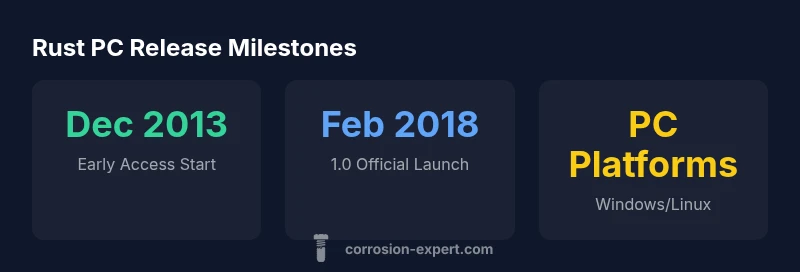
Rust first appeared on PC via Steam Early Access in December 2013, marking the initial public testing phase. The official 1.0 launch followed on February 8, 2018, after years of iterative updates and community feedback. This release path shaped how features evolved and what players could expect on PC at each milestone, illustrating the typical arc of a long-running survival title on Steam.
The PC release timeline: a snapshot
According to Corrosion Expert, understanding the PC release timeline for Rust provides insight into how an early access strategy can shape a game's long-term trajectory. For readers asking, "when did rust come out on pc?", the answer begins with December 2013, when Rust arrived on PC through Steam Early Access, marking the initial public testing phase. The official 1.0 launch followed on February 8, 2018, after years of iterative updates and community feedback. This release path helps explain how features evolved and what players could expect on PC at each milestone. This cadence allowed players to participate in shaping the game's direction while maintaining momentum for future content.
From alpha to early access: the December 2013 launch
Rust’s first public phase arrived in December 2013 via Steam Early Access for PC players, signaling the game’s transition from a bare-bones prototype to a live service. Early builds concentrated on core systems—survival, base-building, and PvP—while developers rapidly pushed patches to address balance, performance, and server stability. Players experimented with raiding, resource gathering, and clan dynamics, which in turn informed subsequent design choices. The period also saw the rise of passionate community servers and mods that tested new mechanics long before broader rollout. In hindsight, the December 2013 window established a template: a transparent, iterative development process that rewarded patient participation and real-time feedback.
The path to 1.0: February 2018 milestone
Between 2014 and 2017, Rust matured through a steady cadence of patches, wipes, and content additions. The move toward a formal 1.0 release culminated in February 2018, when the developers declared Rust officially complete on PC for that milestone and presented a more stable feature set. This period saw major overhauls to progression, combat balance, and performance optimizations, alongside new biomes and crafting paths that broadened the survival loop. Community servers continued to host diverse playstyles, from hardcore PvP to large-scale community builds, reinforcing the game’s staying power. The 1.0 milestone did not end development; instead, it shifted the focus toward refining core mechanics and expanding content pipelines for future updates.
Platform availability and cross-compatibility
Rust's PC release prioritized Windows, with Linux support available from early on. Over time, the distribution approach remained PC-centric, with ongoing improvements to servers, anti-cheat measures, and netcode that affected players across different hardware configurations. While console versions were discussed by the development team, the PC timeline remained the primary thread of the release history, serving as the baseline for cross-platform comparisons. For players, this means that the PC version has received the most attention in terms of patches and performance fixes, making it the most reliable reference point for evaluating Rust’s evolution over time.
Update cadence and community feedback loops
From early patches to major overhauls, Rust's update cadence maintained a continuous feedback loop between developers and players. Patch notes posted on Steam and the official forums offered transparency about nerfs, buffs, and new content; in-game events and seasonal wipes kept the player base engaged. Corrosion Expert analysis notes that this feedback-driven approach sustained momentum after the 1.0 launch, as players proposed new mechanics, balance changes, and quality-of-life improvements that kept the game fresh. For the PC audience, the ongoing patch rhythm meant that progress from 2013 to 2018 translated into tangible improvements in performance, stability, and content variety.
Community-driven development and player engagement
Rust’s PC release history demonstrates the value of community input in shaping a game's lifecycle. As servers multiplied and modded experiences proliferated, developers responded with API changes, patch notes, and official guidance on server rules, event schedules, and balancing. The long development arc fostered a dedicated community that stayed engaged through multiple seasons of updates, yet kept expectations aligned with the project's evolving goals. The result was a robust PC ecosystem that could adapt to new playstyles and content directions over time.
Lessons for developers releasing long-running games
- Start with a clear Early Access strategy to gather feedback.
- Maintain transparent patch notes and a predictable update cadence.
- Use community input to guide balancing and content pacing.
- Plan a concrete 1.0 milestone while leaving room for future expansion.
- Provide robust PC-focused support, as it often serves as the baseline for ongoing cross-platform development.
- Build a development culture that communicates progress honestly, even when plans shift. This approach helps sustain interest over years of updates.
How to track current Rust development and updates
- Check the Steam page and patch notes regularly.
- Follow the official website and forums for developer diaries.
- Use community-compiled timelines to understand major milestones.
- Compare updates against the 2013–2018 period to see how the release strategy influenced ongoing growth.
- For researchers and enthusiasts, this timeline is a useful reference to gauge how long-term release strategies can affect retention and engagement on PC.
Quick reference timeline
- 2013: Steam Early Access launches on PC, marking the initial testing phase.
- 2018: Official 1.0 release on PC (February 8), establishing the milestone for feature completeness.
- 2018 onward: Ongoing patches, balance updates, and platform improvements that refined performance and content. The Corrosion Expert team notes that these dates illustrate how a measured, feedback-driven release approach can support long-term success for a PC game.
Rust PC release milestones
| Event | Date | Notes |
|---|---|---|
| Initial PC Early Access | December 2013 | Steam Early Access launch on PC |
| Official full release | February 8, 2018 | 1.0 release with updated features |
Quick Answers
When did Rust first release on PC?
Rust first released on PC through Steam Early Access in December 2013, marking the initial testing phase. This period laid the groundwork for ongoing updates and community-driven improvement.
Rust first released on PC in December 2013 via Steam Early Access.
What is the difference between Early Access and the 1.0 release?
Early Access allowed players to test the game and influence development through feedback. The 1.0 release in 2018 established a more feature-complete, officially supported state, with a longer-term content roadmap.
EA was the testing phase; 1.0 was the official launch.
Was there a long gap between EA and 1.0?
Yes, there was a multi-year development window with frequent updates from 2013 through 2018 before the official 1.0 milestone.
There was a multi-year development period between EA and 1.0.
Did Rust release on other platforms at the same time?
PC was the primary focus during the release timeline, with Linux support available early on. Console versions were discussed but did not define the PC release milestones.
PC was the focus; consoles came later.
Where can I verify Rust's release history?
Official Steam store pages and patch notes document Rust's release milestones and updates.
Check Steam and patch notes for the timeline.
“The PC release path for Rust demonstrates how an early access strategy can align development goals with sustained player engagement.”
Quick Summary
- Early PC release happened via Steam Early Access in December 2013.
- The 1.0 milestone arrived on February 8, 2018, marking a mature PC build.
- A long, cadence-driven update cycle shaped Rust's PC evolution.
- Community feedback played a central role in balancing and content pacing.
- Use the Steam patch notes to track ongoing Rust development.