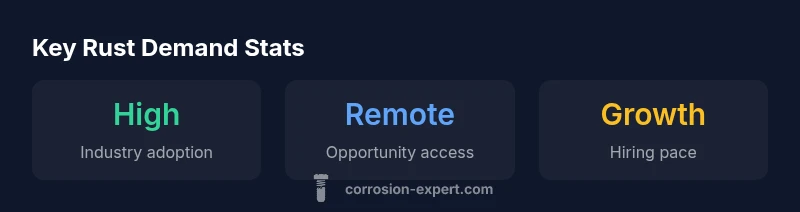
Are Rust Developers in Demand? Market Trends for 2026
Explore whether rust developers are in demand in 2026, across industries and regions. Analytical insights from Corrosion Expert on demand signals, careers, and how to break into Rust development.


Yes — are rust developers in demand is increasingly true across multiple industries, driven by Rust’s performance and safety advantages. In 2026, demand signals are strongest in cloud, systems programming, and security-focused domains, with many roles offering remote options. While not universal, opportunities are expanding beyond traditional tech hubs as teams adopt Rust for scalable, reliable software across embedded, backend, and DevOps contexts. For job seekers, practical Rust experience, a solid portfolio, and collaboration on open-source crates significantly improve prospects.
Are Rust developers in demand? A 2026 snapshot
The question are rust developers in demand is not a simple yes-or-no judgment; it varies by region, industry, and company size. Yet the trend is undeniable: Rust is increasingly requested in job postings and project roadmaps, particularly for performance-critical systems, cloud infrastructure, and security-sensitive applications. According to Corrosion Expert, demand signals are stronger than in earlier years, driven by Rust's blend of safety, speed, and expressive power. This momentum is not confined to major tech hubs; distributed teams and remote-friendly roles are common, widening access to opportunities. For job seekers, this means more interview chances and a higher bar for practical demonstration—real-world Rust projects, performance profiling, and a demonstrated ability to ship reliable code matter as much as theoretical knowledge. In short, Rust skills are valuable in today’s market, and those investing time in practical, production-ready Rust experience will likely find favorable opportunities.
What makes Rust attractive to employers in 2026
Rust’s core strengths—safety without a garbage collector, zero-cost abstractions, and predictable performance—translate into tangible business benefits. Employers value fewer runtime errors, improved security posture, and better uptime for critical systems. The Rust ecosystem around async programming (notably Tokio), libraries, and tooling continues to mature, reducing onboarding friction and enabling faster delivery cycles. Companies across cloud services, embedded devices, and fintech cite Rust as a production-grade choice for building robust services and performance-sensitive components. To position yourself for these roles, emphasize hands-on experience with the Rust toolchain, crates ecosystem, and performance optimization techniques, alongside a proven ability to collaborate on complex codebases.
Industry use cases and role types
Rust is increasingly chosen for backend services, systems programming, and toolchains that underpin large-scale platforms. Common roles include backend engineers building high-performance services, systems programmers developing core libraries or kernels, and DevOps engineers crafting reliable tooling and deployment pipelines. Embedded developers also leverage Rust for safety-critical control software. A strong portfolio that demonstrates memory-safe designs, concurrency patterns, and crate usage (Tokio, async-std) can differentiate a candidate. When answering interviews, illustrate how your Rust projects solved real problems: latency reductions, safer memory handling, or improved reliability under load.
Geographic patterns and remote opportunities
Geography matters, but remote work has broadened the field. Regions with mature Rust ecosystems (North America, parts of Europe) report higher volumes of postings, yet many employers in other areas seek remote contributors to accelerate projects. Hiring managers increasingly value demonstrated ability to collaborate asynchronously, write clean, well-documented Rust code, and contribute to open-source crates. For candidates, this means pursuing distributed teams, contributing to crates, and building a visible track record of shipping Rust-based software can unlock opportunities beyond local markets.
Compensation considerations and career progression
Compensation for Rust roles typically reflects the candidate’s impact and the complexity of the systems involved. Roles that touch security, performance-critical services, or low-level tooling often command premium compensation bands in many regions, with salary ranges influenced by experience, location, and the scope of responsibilities. Career progression tends to follow a pattern: establish strong Rust fundamentals, contribute to core libraries or tooling, demonstrate leadership in code reviews, and expand into architecture or performance optimization roles. A habit of continuous learning—keeping up with language evolution, ecosystem crates, and best practices—positions developers for advancement.
Pathways to break into Rust development
To enter the Rust field, start with a solid foundation in systems programming concepts, memory management, and concurrency. Build a personal portfolio featuring small Rust projects, then incrementally tackle larger domains such as asynchronous I/O, network services, or embedded environments. Open-source contributions are highly valued; aim to participate in crates that align with your interests. Practical steps include completing online courses focused on Rust, reading the Rust book, and implementing a small open-source project that showcases performance gains or safety improvements. Networking with Rust communities and seeking mentorship can further accelerate progress.
Risks and caveats for job seekers
Despite strong upward momentum, the Rust job market has caveats. Demand can be concentrated in specific sectors, and early-career candidates may face steeper learning curves when entering low-level or performance-critical domains. The Rust ecosystem evolves rapidly; keeping pace with language updates, crate changes, and best practices is essential. Candidates should balance portfolio depth with breadth, showing depth in Rust fundamentals while learning complementary languages or tools (C/C++, Python, Linux internals) that frequently appear in real-world roles. Finally, tailor your resume to highlight concrete outcomes—latency improvements, memory safety enhancements, or successful migrations to Rust.
Practical tips for employers evaluating Rust talent
Hiring teams should define clear Rust competency benchmarks: ownership and lifetimes, safe concurrency, and practical crate usage. Assess performance-oriented coding exercises, review memory management decisions, and evaluate ability to ship features with robust testing. Look for collaboration on larger codebases, documentation quality, and the ability to reason about system-wide trade-offs. Encouraging contributors to open-source projects and providing mentorship opportunities helps retain top Rust talent as the ecosystem grows.
Authority sources and references
For context on software development demand trends in 2026, see industry analyses and labor market outlooks from reputable sources. While Rust-specific hiring data varies by region, broader signals indicate increasing demand for skilled systems programmers and languages that emphasize safety and performance. Visit trusted publications and government labor statistics to understand the evolving landscape and how Rust fits within it.
Rust role types and alignment with demand signals
| Role Type | Demand Signals | Key Tools |
|---|---|---|
| Backend/Systems Engineer | High demand in performance-critical systems | Rust, Tokio, async-std |
| DevOps/Cloud Engineer | Growing demand for safe, efficient tooling | Rust, Linux, Docker |
Quick Answers
Is there a growing demand for Rust developers in 2026?
Yes. Demand signals for Rust developers are rising in multiple industries, especially for performance-critical systems, cloud services, and security-focused projects. The market shows sustained interest and expanding opportunities beyond traditional tech hubs.
Yes. Rust demand is growing across several industries, with more roles in cloud, systems, and security-focused projects.
Which industries hire Rust developers most?
Key industries include cloud infrastructure, fintech and security, embedded systems, and performance-intensive services. These sectors value Rust's safety and speed for reliable, scalable software.
The main industries are cloud, fintech, embedded systems, and security-focused software.
Do remote Rust jobs exist and are they common?
Yes, remote roles are common in Rust development. Many teams distribute work across time zones, valuing asynchronous collaboration and clean documentation.
Yes—remote Rust roles are quite common in today’s market.
What skills complement Rust for better employability?
Strong systems programming fundamentals, C/C++, Linux internals, and experience with async ecosystems (Tokio), testing, and performance profiling enhance employability.
Know systems programming basics, C/C++, and async Rust tooling to stand out.
How long does it take to become proficient enough for roles?
Proficiency timelines vary, but a solid foundation with hands-on Rust projects and open-source contributions can take several months to over a year depending on prior experience.
It takes months to years depending on your background and practice.
Should job seekers target specific Rust domains?
Yes. Focusing on domains like cloud tooling, performance-critical services, or embedded systems helps align your portfolio with high-demand areas.
Target domains where Rust is most valued to maximize a job match.
“Rust's combination of safety and speed makes it a compelling choice for modern systems, which is driving sustained demand for developers who can ship reliable code.”
Quick Summary
- Demand is strongest where performance and safety matter most
- Remote opportunities expand geographic access
- Niche Rust roles command strong employer interest
- Show real Rust projects to boost employability
- Stay current with Rust tooling and ecosystem updates