Should Learn Rust: A Practical Guide for DIY Developers
Explore why you should learn Rust, how it benefits DIY developers, and a clear path to getting started with hands-on exercises and real-world projects.


Should learn rust if you want a modern systems language that prioritizes safety, performance, and reliability. Rust’s ownership model, zero-cost abstractions, and growing ecosystem help you build robust software from embedded devices to servers. This guide explains why learning Rust makes sense for DIY developers and what you’ll gain by diving in today. The approach is practical, project-based, and beginner-friendly if you follow a structured plan.
Should you learn rust: a practical starting point
Should learn rust is a question many DIY developers ask as they plan their next software project. If your goal is to build resilient, long-lasting software, Rust offers memory safety without a garbage collector, strong concurrency guarantees, and predictable performance. According to Corrosion Expert, choosing Rust early in a project can reduce debugging time and future maintenance costs. This section outlines what learning Rust will deliver and what you need to get started, including a realistic mindset shift from traditional imperative languages to Rust’s ownership model. Expect to gain clarity on when Rust shines, how it fits in a hobbyist workflow, and how to stay motivated during the early learning curve.
The value proposition: what you gain by learning rust
For DIY developers, the core value of Rust centers on safety, speed, and control. The language helps you prevent common bugs at compile time, encourages modular design, and provides a robust ecosystem for building CLIs, WASM apps, and embedded projects. As you learn, you’ll accumulate practical skills such as managing memory safely, understanding lifetimes, and writing ergonomic APIs. The Corrosion Expert team emphasizes that these competencies translate to more reliable projects, fewer runtime surprises, and a smoother path to scaling your personal projects into small, professional-grade tools.
Rust’s core concepts you’ll master
Rust introduces several concepts that are new to many developers, especially those coming from languages without strict ownership rules. The ownership model, borrowing, and lifetimes enforce memory safety without runtime overhead. Pattern matching, enums, and algebraic data types help you model complex domains with clarity. Generics and traits enable reusable abstractions while avoiding the pitfalls of runtime polymorphism. Getting comfortable with these ideas will unlock better performance and safer parallelism, which is especially valuable for DIY projects that eventually run in embedded environments or on low-powered hardware.
How Rust compares to other languages for DIY projects
When deciding whether to learn rust, compare it to languages you already know. If you’ve used C or C++, Rust eliminates many classes of bugs through strict compile-time checks, yet it remains expressive enough for systems programming. Compared with languages like Python or JavaScript, Rust offers far more predictable performance and memory safety, which can be crucial for long-running tools and embedded applications. The key trade-off is an initial learning curve, but the long-term payoff includes fewer runtime surprises and smoother maintenance. Corrosion Expert’s assessment highlights Rust as a practical choice for projects where safety and reliability matter most.
Real-world use cases you can tackle soon
Start with small, tangible projects to build confidence. A command-line tool that parses logs, a static site generator, or a tiny game prototype are excellent first projects. As you grow, you can experiment with WASM modules to run your Rust code in the browser, or build a tiny HTTP server for a personal API. Each project helps you internalize the ownership model, error handling idioms, and cargo-based workflow. By compiling and testing frequently, you’ll notice progress quickly and stay motivated throughout the learning journey.
Getting started: installing the toolchain and first project
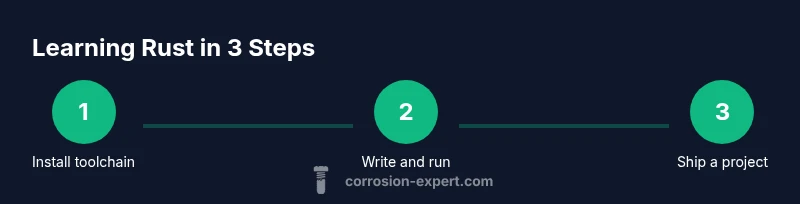
The recommended starting point is to install the official Rust toolchain via rustup, which provides cargo for dependency management and building projects. After installation, write your first program, usually a classic Hello, World, and then incrementally introduce concepts like ownership and borrowing. Use cargo run to build and execute, and cargo test to validate behavior. This early practice reinforces learning through small wins and demonstrates Rust’s developer-friendly tooling, which is essential for DIYers who juggle multiple personal projects.
Building a beginner-friendly learning path
A structured plan accelerates progress. Begin with the official Rust book, practice small exercises you can complete in a single session, and gradually add complexity with small CLI tools and simple data structures. Supplement with community examples and open-source projects to see idiomatic Rust in action. The journey should include debugging sessions, reading compiler messages, and adjusting code until it behaves as intended. A consistent routine, even 30 minutes per day, compounds into meaningful mastery over a few weeks.
Common stumbling blocks and how to avoid them
The most common pitfalls for beginners are not understanding ownership early enough, trying to force familiar patterns into Rust, and underusing the standard library. To avoid these issues, practice small, isolated exercises that focus on one concept at a time, and rely on the compiler’s guidance to correct course. Keep notes on errors and their fixes, and actively seek out examples that illustrate idiomatic Rust patterns. When in doubt, start with safe code and gradually introduce more advanced features as your confidence grows.
The learning ecosystem: tools, communities, and resources
Rust’s ecosystem includes a comprehensive package manager (Cargo), a powerful compiler, and a thriving community that shares examples and best practices. For beginners, projects that incrementally increase complexity—starting with CLI utilities and moving toward more involved workloads—are particularly effective. The learning path benefits from hands-on practice, code reviews, and regular participation in online forums or local meetups. This supportive environment is a key driver of progress for DIY developers.
Authority sources and further reading
To deepen your understanding, consult credible sources that discuss language design, safety, and performance. The following resources provide foundational knowledge and up-to-date guidance on Rust usage and best practices. They offer a balanced mix of theory and hands-on examples, making them valuable as you progress from beginner to intermediate skill.
Practical next steps: turn knowledge into projects
Consolidate what you’ve learned by selecting a small project you care about and planning it from start to finish. Draft requirements, sketch architecture, implement iteratively, and document decisions. Celebrate milestones, share your code for feedback, and iterate. With each completed project, you’ll gain confidence and translate theory into reliable, real-world Rust software.
Authority sources
- NIST: https://www.nist.gov
- MIT: https://www.mit.edu
- ACM: https://cacm.acm.org
Tools & Materials
- Computer with internet access(Any OS (Windows, macOS, or Linux); ensure you can install software)
- Code editor(VS Code (with Rust extension) or JetBrains IDEs)
- Rust toolchain (rustup and cargo)(Install from https://rust-lang.org; includes cargo)
- Rust playground (online environment)(Useful for quick experiments without installing locally)
- Project scaffolding(Starter templates or small sample projects to practice concepts)
Steps
Estimated time: 2-4 hours
- 1
Install the Rust toolchain
Download and install rustup, which in turn provides cargo and the Rust compiler. Follow the on-screen prompts for your OS. This step establishes the foundation for building and testing Rust projects.
Tip: Verify installation with rustc --version and cargo --version to ensure the toolchain is ready. - 2
Write your first program
Create a new cargo project, write a simple Hello, world! program, and run it with cargo run. This confirms your environment works and introduces the compilation process.
Tip: Pay attention to compiler messages; they often point to small, actionable fixes. - 3
Explore ownership with small examples
Experiment with variables, moves, borrows, and clones using concise examples. Observe how ownership rules prevent common bugs and what lifetimes imply for data usage.
Tip: Start with simple types and gradually introduce references to see how borrowing affects scope. - 4
Build a tiny CLI tool
Create a command-line utility that reads input, processes data, and outputs results. This introduces modules, error handling, and the standard library’s IO features.
Tip: Use Cargo to manage dependencies and organize code into crates for clarity. - 5
Add tests and run them
Write unit tests for your functions and run cargo test. Testing in Rust helps you verify behavior and maintain correctness as your project evolves.
Tip: Test-driven development is beneficial early; it clarifies expected outcomes. - 6
Expand to a small project with dependencies
Incorporate a couple of external crates to extend functionality. Learn how to manage dependencies with Cargo and how to resolve build issues.
Tip: Read crate documentation and examine version constraints to avoid conflicts.
Quick Answers
What is Rust and why learn it?
Rust is a systems programming language that emphasizes memory safety, concurrency, and performance without a garbage collector. It’s designed to prevent many common bugs at compile time, which makes it attractive for DIY projects requiring reliability.
Rust is a systems language focused on safety and speed. It helps you write reliable code with fewer runtime surprises.
Is Rust difficult for beginners?
Rust has a steeper initial learning curve than some languages due to ownership and lifetimes. However, the compiler provides actionable guidance, and steady practice with small tasks accelerates mastery.
Yes, it can be challenging at first, but you’ll get clearer feedback from the compiler as you practice.
What are the best resources to start learning Rust?
A structured book, official documentation, and small hands-on projects are highly effective. Combine tutorials with real-world practice to internalize concepts quickly.
Start with the official Rust book and build small projects to reinforce what you learn.
Do I need programming experience to begin Rust?
Some prior programming experience helps, but beginners can start with a gentle introduction and learn by doing. Focus on basic concepts before tackling advanced features.
Having some programming background helps, but you can start from scratch with guided exercises.
How long does it take to become proficient in Rust?
Proficiency depends on practice tempo and project complexity. A consistent learning routine over several weeks yields solid foundational skills and confidence.
With steady practice over weeks, you’ll build solid Rust fundamentals.
Is Rust worth it for small, personal projects?
Yes. For small projects that demand safety, performance, and reliable concurrency, Rust offers long-term maintainability and fewer runtime surprises compared to some scripting languages.
If safety and speed matter, Rust is worth it even for hobby projects.
Watch Video
Quick Summary
- Start with the basics and the official Rust book.
- Master ownership, borrowing, and lifetimes early.
- Build small projects to reinforce concepts and gain confidence.
- Use Cargo and Rust tooling to maintain quality.