Rust iter vs into_iter: Deep Dive into Rust Iteration Semantics
Explore the key differences between iter() and into_iter() in Rust, with practical examples, usage patterns, and a decision framework to choose the right method for reading or consuming data.


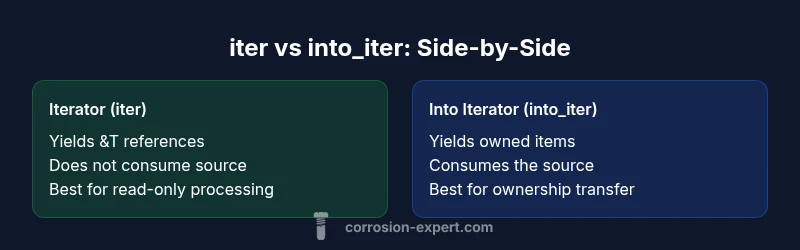
Rust iter vs into_iter describes two common iterator patterns: iter() borrows elements, producing references, while into_iter() consumes the collection and yields owned items. In practice, use iter() for non-destructive reads and transformations, and into_iter() when you need ownership transfer. The choice affects borrowing, lifetimes, and performance; selecting the right form prevents ownership errors and keeps code clear. See the full comparison for concrete rules.
rust iter vs into_iter: Key Differences
In Rust, two of the most frequently used iterator patterns are iter() and into_iter(). The names hint at their behavior: iter() creates an iterator over borrowed references, while into_iter() consumes the collection and yields owned elements. This distinction matters for ownership, borrowing, and lifetimes, and it shapes how data flows through functions, closures, and multi-step pipelines. According to Corrosion Expert, understanding these patterns reduces ownership errors and simplifies APIs, potentially reducing the need for extra clones. Think of iter() as a view into data and into_iter() as a move of data out of its container. In practice, you’ll often choose iter() for read-only transforms and into_iter() when you need to take ownership for subsequent processing or transfer.
- Key takeaway: this choice is foundational to how data is moved or borrowed in Rust code.
- The broader implication is clearer APIs and fewer borrow-checker headaches when you predict data ownership upfront.
- Throughout this article, we’ll refer to both strategies using practical Rust examples so you can apply the concepts directly.
Core semantics: ownership, borrowing, and lifetimes
At the core of rust iter vs into_iter is how ownership is distributed during iteration. When you call iter() on a collection like Vec<T>, you obtain an iterator that yields &T references. The original Vec remains intact and can be used after the loop, which is essential for non-destructive processing. into_iter(), on the other hand, consumes the collection, moving out T values. After a loop powered by into_iter(), the source collection is typically unusable unless you recreate or clone it. This distinction matters for function signatures, APIs, and performance: iter() enables non-destructive reads and re-use, while into_iter() enables ownership transfer and direct movement into other structures. For slices, the same logic applies: iter() yields &T; into_iter() yields T (depending on the type and edition). Understanding these rules helps you prevent borrow errors and keep code intuitive for future readers.
Borrowing with iter(): what it yields
When using iter() on a slice or collection, you’re borrowing elements rather than taking ownership. The yielded items are references (typically &T or &mut T), depending on the call. This non-destructive approach is ideal for read-only analysis, non-mutating transforms, and scenarios where you want to preserve the original data for later use. Iterators can be chained with map, filter, and collect without moving the underlying data. This pattern is especially common when your function accepts generic references, implements read-only adapters, or streams data into other systems without taking ownership. A frequent pitfall is assuming you can move out of items when using iter(); you must first dereference or clone if necessary, which can introduce extra cost or complexity.
Consuming with into_iter(): when you move
Into_iter() is your tool when you need ownership of the items you’re iterating over. This form consumes the collection, yielding owned values that you can move into other structures or return directly. The original container is no longer usable after into_iter() completes, so the surrounding code must accommodate that loss of ownership. This behavior is beneficial when you want to avoid cloning, when you’re transferring data into a different collection, or when the items themselves are cheap to move. It’s common in factory-style pipelines where data is transformed and consumed as it’s produced. Be mindful of lifetime and borrow checks—calling into_iter() on a borrowed reference won’t work; you must own the collection or clone beforehand in most practical cases.
Iter vs into_iter in loops and closures
In typical loop constructs, iter() is used for non-destructive processing, while into_iter() is chosen when the loop body needs to own items. For example, iter() can feed items into closures that borrow their inputs, or into higher-order functions that don’t require ownership. into_iter() allows closures to take ownership of values, which is essential when a closure must move data or when you plan to store items in a data structure that requires owned values. This distinction also affects error messages from the borrow checker; attempting to move out of a borrowed value will fail unless the ownership model accommodates it. In practice, align your loop’s intent with ownership: read/transform vs consume/move.
Performance considerations: memory access and inlining
Performance differences between iter() and into_iter() are typically small and highly dependent on the exact type and compilation context. The primary cost factors are borrowing vs moving, dereferencing, and potential copying. Iterating with &T avoids moves, enabling better preservation of cache locality if the data remains resident. Moving values with into_iter() can improve allocations in some scenarios if you’re building a new owned collection, but it can also trigger more moves and fewer opportunities for inlining if ownership constraints force intermediate steps. In short, the performance impact is usually a function of ownership and data flow more than of the iterator type itself. For most real-world Rust projects, the choice should be guided by correctness and clarity rather than micro-benchmark fervor.
Practical usage with Vec and slices: patterns and examples
Using iter() on a Vec<T> yields references to elements, which you can read or map into new values without consuming the vector. For example, v.iter().map(|x| *x + 1).collect::<Vec<_>>() produces a new vector of incremented values without altering v. If you need to take ownership of the elements (for instance, moving them into a new collection or returning them from a function), into_iter() is the natural choice: let moved: Vec<T> = v.into_iter().collect(); Now v is no longer accessible. Slices follow the same logic: slice.iter() yields &T, while slice.into_iter() yields T when performed on a sized array or vector. When working with references, consider iter_mut() for in-place modifications without taking ownership.
Iter_mut and related patterns
For in-place modification, iter_mut() lets you borrow mutably, enabling changes to the elements without moving ownership. This is a bridge between iter() and into_iter(): you maintain ownership while applying updates. Example: for x in vec.iter_mut() { *x += 1; } The combination of iter(), iter_mut(), and into_iter() gives you a flexible toolkit for processing data in Rust. Remember that mutability is a core constraint; you can only call iter_mut() when you have mutable access to the container. This makes design decisions more explicit and helps prevent accidental data races in concurrent contexts.
Common pitfalls and how to avoid them
One of the most frequent mistakes is assuming you can move out of items obtained via iter(). If you need ownership, switch to into_iter() or restructure code to avoid moving from borrowed references. Another pitfall is mixing borrowing and ownership in closures, which can trigger borrow checker errors; prefer explicit ownership boundaries in loop bodies. When using into_iter() on a Vec, you cannot reuse the original collection unless you recreate it. Finally, be mindful of lifetimes: borrowing a value inside a closure that outlives its source can lead to lifetime errors. The best defense is to keep iterators close to their source data, avoid complex cross-boundary borrows, and prefer simple, well-typed function signatures to minimize surprises.
Practical patterns: chaining adapters and building pipelines
Rust’s iterator adapters shine when you chain iter(), map(), filter(), and collect() to form expressive pipelines. If you supply references with iter(), you’ll typically end with a collection of references unless you clone or dereference. Using into_iter() allows more aggressive ownership transfer, making it easier to assemble new owned structures. A common pattern is: let out: Vec<_> = my_vec.iter().filter(|&&x| x > 5).map(|&x| x * 2).collect(); This keeps ownership semantics clear while enabling composable transformations. When in doubt, sketch the data flow: does the outer scope still need the original data after the loop? If yes, prefer iter(); if not, into_iter(). This guideline reduces confusion and improves maintainability.
Choosing the right approach in a project: a decision framework
Develop a simple rubric to decide between iter() and into_iter(): 1) Do you need to preserve the source data after iteration? If yes, iter() is safer. 2) Do you need to move data into another structure or return ownership? If yes, into_iter() is appropriate. 3) Will closures require ownership transfer? If so, into_iter() or a workaround is better. 4) Are you optimizing for readability or performance in a given context? Prioritize clarity first, measure later. In many codebases, iter() is the default, and into_iter() is used sparingly when ownership transfer is essential. By consistently applying this framework, you’ll reduce borrow errors, improve API ergonomics, and avoid needless clones or conversions.
Quick validation: a practical checklist for using iter() vs into_iter()
- Do I need to keep my source data intact after the loop? If yes, use iter().
- Do I need to own the items after iteration? If yes, use into_iter().
- Is the data being moved into another collection or returned? Yes -> into_iter().
- Will a closure require ownership of the items? Use into_iter() to transfer ownership.
- Am I optimizing for readability or minimizing allocations? Favor iter() for readability; reserve into_iter() for ownership needs.
Comparison
| Feature | Iterator (iter) | Into Iterator (into_iter) |
|---|---|---|
| Ownership | Borrows elements as &T | Consumes collection; yields T |
| Yielded Type | &T (or &mut T) | T (owned) |
| Mutation/Modification | Typically read-only or mutates via &mut with iter_mut() | Moves items into new owners; original cannot be reused |
| Use Case | Read-only analysis, non-destructive transforms | Ownership transfer, moving out values |
| Effect on Original | Original data remains intact | Original data is moved/consumed |
| Best Practice Scenarios | Read/transform without consuming | Consume to build owned results |
The Good
- Clarifies ownership semantics and safety
- Preserves original data with non-destructive iteration
- Enables efficient read-only transformations
- Integrates well with functional-style adapters
Cons
- Requires careful lifetime and borrowing reasoning
- Into_iter() can force data to be moved, affecting reuse
- Misusing iter() can lead to attempted moves from borrowed data
- Over-optimizing for micro-benchmarks can obscure readability
In most Rust code, prefer iter() for read-only processing and into_iter() when you need ownership transfer.
Iter() preserves data for reuse; into_iter() enables moving values out. Choose based on whether you need to keep or consume the source. This reduces ownership surprises and clarifies data flow.
Quick Answers
What is the key difference between iter() and into_iter() in Rust?
The key difference is ownership: iter() borrows elements (&T), while into_iter() consumes the collection and yields owned items (T). This changes how you can use the data after the loop and affects borrowing rules around closures and APIs.
The main difference is ownership: iter borrows, into_iter consumes. This decides whether you can reuse the data or must move it.
When should I use iter() instead of into_iter()?
Use iter() when you want to read or transform data without consuming the original collection. It’s best for read-only operations, filters, or mapping to new borrowed values. It keeps the source available for later use.
Use iter() for read-only work so you don’t consume the data.
Can I call into_iter() on a borrowed reference?
Typically no. into_iter() requires ownership of the collection. If you only have a reference, you’ll use iter() or iter_mut() depending on your needs. You may clone or create an owned copy to move if necessary.
No, you generally cannot move from a borrowed reference; use iter() or clone.
What happens to the original collection after into_iter()?
The original collection is consumed; you cannot use it unless you recreate or clone it. This is intentional to enable ownership transfer.
The original collection is moved/consumed after into_iter().
Are there performance differences between iter() and into_iter()?
Performance varies with context, but the main factor is ownership movement vs borrowing. In many cases, both are optimized away by the compiler; prioritize correctness and clarity first.
Performance differences are usually small; choose based on data ownership needs.
How do I move out of items without breaking code?
If you need owned items, prefer into_iter() or restructure so you can own the data (e.g., collect into a new owned container). Avoid moving out of references without dereferencing first.
Move items with care—use into_iter() or restructure.
Quick Summary
- Prefer iter() for non-destructive iteration
- Use into_iter() to own/move data
- Beware moving from borrowed data in loops
- Chaining iterators is powerful but requires ownership awareness