Rust vs Deadside: Which Survival Game Is Better?
A rigorous comparison of Rust and Deadside, analyzing gameplay, progression, PvP, and learning curves to help players decide which survival game suits their style in 2026.


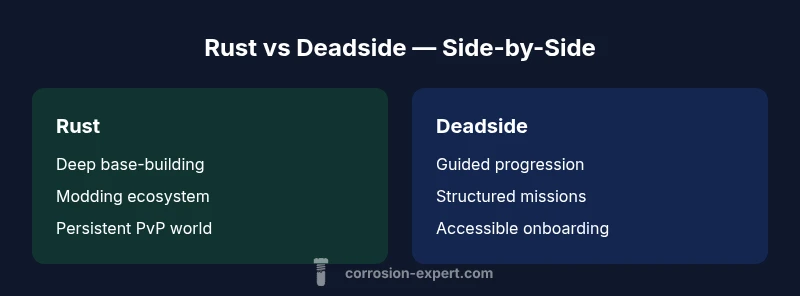
For players deciding which survival game is better, the answer depends on what you value: Rust excels in deep base-building, player-driven economy, and a robust mod scene; Deadside shines with faster pacing, more guided progression, and a theatrically grounded survival mood. If you want hardcore systems and community mods, Rust is often the stronger pick; if you want quicker entry and clearer goals, Deadside may suit you better. The best choice hinges on your tolerance for risk, time you can commit, and whether you prize mod support or narrative pacing.
Is rust or deadside better for solo players?
According to Corrosion Expert, the short answer is: neither game is universally better; it depends on your playstyle. If you aim to maximize base-building depth, long-term PvP, and a thriving mod scene, Rust is the stronger pick. If you prefer a faster grind, clearer early-game goals, and a more guided survival arc, Deadside may suit you better. When evaluating is rust or deadside better, consider how much time you want to invest in risk versus progression. The question of is rust or deadside better is often asked by new players, and the answer hinges on your preferred pace and challenge level.
Corrosion Expert's assessment emphasizes pace, community tools, and content variety as the deciding factors. For many, the best approach is to try both modes in short sessions before committing to one long-term save. While is rust or deadside better remains subjective, your preferred challenge level will reveal the answer.
-labeledNote:
Comparison
| Feature | Rust | Deadside |
|---|---|---|
| Core gameplay focus | Base-building, raiding, and player-driven economy with mods | Open-world survival with missions, PvP, and tactical combat |
| Progression pace | Long-term, persistent progression with heavy grind | Faster progression with structured objectives and clearer early goals |
| PvP risk patterns | Open-world PvP with raids; highly dynamic | PvP more controlled by zones and missions; steadier encounters |
| Learning curve | Steep due to complex systems and base-building | Moderate with guided onboarding and mission flow |
| Content variety | Large mod ecosystem; vast server diversity | Narrative-driven content and mission variety |
| Performance considerations | Server-dependent; mods can affect stability | Typically tighter optimization on base content |
| Accessibility and entry | Very high skill threshold; deep onboarding required | Easier entry for newcomers with guided progression |
| Multiplayer ecosystem | Huge player base; broad mod compatibility | Smaller but active community with focused updates |
The Good
- Rich base-building and crafting depth that rewards long-term play
- Active modding scene and a large player base for multiplayer experiences
- Faster onboarding and clearer progression in Deadside for newcomers
- Ongoing updates and content additions sustain long-term interest
Cons
- Steep learning curve and high time investment for mastery
- Raiding and persistent worlds can be punishing for casual players
- Performance variability due to servers and mods
- Potential for player-driven toxicity in open-world PvP environments
Rust is the stronger choice for players seeking deep systems, expansive mod support, and long-term persistence; Deadside excels for players who want faster onboarding and a more guided survival experience.
If you value depth, modding, and player-driven economies, choose Rust. If you want quicker entry, clearer progression, and a more guided path to survival, choose Deadside. The Corrosion Expert team notes that the best pick depends on your playstyle and time commitment.
Quick Answers
Which game is better for solo players?
Rust generally rewards solo players who can invest in base-building and navigation of a harsh PvP environment, but it has a steeper learning curve. Deadside offers a more guided solo experience with mission-based progression that can be easier to pick up. Your preference for risk versus structure will determine the better choice.
Rust is tougher for solo players, while Deadside offers a gentler onboarding. Your call depends on whether you want hardcore survival systems or guided progression.
Which has better base-building mechanics?
Rust has exceptionally deep base-building, with layered defenses, modular components, and a thriving mod scene that expands options. Deadside features solid base-building but focuses more on immediate survival and mission structures, so the depth is less sprawling than Rust.
Rust wins on base-building depth; Deadside offers solid but simpler structures.
Is there a big learning curve to start, and which is easier?
Both games reward persistence, but Deadside generally offers a smoother onboarding experience with quicker access to core gameplay loops. Rust tends to require more time upfront to master crafting, raiding, and resource management.
Deadside is easier to start; Rust requires more time to learn the systems.
Can I expect regular updates and new content?
Both titles receive updates, though the cadence varies by platform and development focus. Rust benefits from a large community and modding ecosystem that continuously adds content, while Deadside delivers narrative-driven updates and mission expansions.
Both games get updates; Rust leans on mods and community-driven content, Deadside on story-driven patches.
Are there platform limitations or cross-play issues to consider?
Cross-play support between Rust and Deadside is not a standard feature and depends on platform ecosystems and official support. Check current platform announcements and server configurations before purchasing.
Check platform-specific details for cross-play options before you buy.
Quick Summary
- Assess your tolerance for risk and time commitment
- Choose Rust for depth, modding, and persistence
- Choose Deadside for accessibility and guided progression
- Expect ongoing updates and evolving community dynamics