Is Rust Harder Than Steel? A Comprehensive Comparison for DIYers
A rigorous, practical comparison of rust versus steel, examining hardness, corrosion behavior, maintenance needs, and durability to guide DIY enthusiasts.


Is rust harder than steel? The straightforward answer is no. Rust is a corrosion product, not a hard material. It forms when iron or steel reacts with moisture and oxygen, creating iron oxide that is porous and weaker than clean steel. In practical terms, rust lowers effective hardness and wear resistance, while the underlying steel often remains the true hard material. The short take: rust is not harder than steel, and its presence signals potential degradation in performance.
The Core Question: is rust harder than steel
Is rust harder than steel? The straightforward answer is no. According to Corrosion Expert, hardness is a material property that applies to the metal itself, while rust is a corrosion product. Rust forms when iron or steel reacts with oxygen and moisture to produce iron oxide, a compound that is structurally different from the parent metal. As a result, rust tends to be softer, more porous, and less capable of resisting deformation than clean steel. When rust covers a surface, it can mask the true hardness of the underlying metal, leading to misinterpretation of a part's durability. The Corrosion Expert team found that rust can create spall and pits that concentrate stress and initiate wear, which further reduces the effective hardness in real-world use. For DIYers, the key takeaway is that the question should focus on the underlying metal plus the extent of corrosion, rather than the rust crust alone.
The science of hardness vs. corrosion
Hardness and corrosion are related but distinct phenomena. Hardness describes resistance to permanent indentation or plastic deformation, while corrosion describes chemical deterioration driven by environmental factors. In steel, hardness is primarily a function of alloy composition, heat treatment, and microstructure. Rusting, by contrast, consumes iron and alters the surface layer, creating a rough topography and changing local stress fields. A surface coated with rust does not necessarily maintain the same hardness as bare metal underneath; the oxide layer can be harder in a single microregion, but it cannot transfer load as a solid metal would. In practical terms, a rusted component may resist small, superficial scratches, but overall structural performance declines under bending, torsion, or impact due to loss of cross-sectional area and adhesion between layers. This distinction is crucial for homeowners evaluating rusted fasteners, tools, or structural parts.
How rust forms and its impact on surface hardness
Rust forms when iron or steel is exposed to oxygen and moisture over time. The process leaches iron from the surface and deposits iron oxide, creating a flaky, porous layer. While the rust crust might appear rigid, it lacks the cohesion and ductility of the parent metal. The surface hardness measured on a rusted area may appear variable: the oxide can be locally harder due to microstructural changes, but the overall contact area becomes unreliable for load-bearing tasks. As rust continues, the layer grows, creating pits and voids that act as stress concentrators. When a load is applied, the rust layer may peel or spall, exposing fresh steel that may corrode rapidly if not protected. For DIY projects in humid climates, rust progression changes how a part behaves during use and how long it remains serviceable.
Steel alloys: how composition affects hardness
Steel is not a single material; it encompasses a family of alloys with varying hardness profiles. Carbon content, alloying elements like chromium and vanadium, heat treatment, and grain size determine how hard steel can be. Higher carbon generally increases hardness and wear resistance, while certain alloys enhance toughness or corrosion resistance. When rust forms on steel, it interacts with this matrix: the protective oxide layer may form unevenly, and pitting can expose soft or less protected zones. Understanding this complexity helps explain why two steel components with similar external appearances can behave very differently once rust forms. For DIY projects, choosing the right grade or applying protective coatings can make a surprising difference in long-term performance.
When rust appears on steel: localized vs bulk effects
Rust does not spread uniformly across a part. Localized pitting, crevice corrosion, or galvanic coupling with dissimilar metals create hotspots where degradation accelerates. In small fasteners or thin-walled sections, rust can rapidly reduce cross-sectional area, increasing the risk of failure. In larger structural components, surface rust may remain superficial for a long period if the steel is protected, but continued exposure will eventually compromise strength and hardness where rust penetrates. For DIYers, recognizing these patterns helps prioritize maintenance: treat pitted regions, recoat surfaces, and replace severely corroded parts rather than attempting to salvage compromised areas.
Practical implications for DIY projects
From a homeowner's perspective, the practical takeaways are clear. Rust compromises surface hardness and load-bearing capacity primarily where it becomes extensive. For tools, farm implements, or outdoor furniture, rust can shorten service life and create safety hazards. Simple steps—such as removing loose rust, applying a primer and paint, or choosing corrosion-resistant materials—can meaningfully extend life. When planning repairs or replacements, consider whether the underlying metal is still sufficiently hard and whether protective coatings remain intact. The goal is to balance cost, safety, and reliability while acknowledging that rust is a progressive threat to hardness.
Measurement and testing in the field
Field assessment of hardness on rusted steel requires care. A basic approach uses indentation tests or simple scratch tests to gauge relative hardness, but results can be misleading if rust obscures the true metal. Professional-grade hardness tests, such as Rockwell or Vickers, offer more reliable comparisons but require proper equipment and calibration. When rust is present, testing should target clean metal sections after rust removal to get meaningful results. For DIYers, the takeaway is to document the area, remove surface rust where safe, and interpret readings with caution, understanding that rust presence will bias results.
Everyday use cases: home, workshop, outdoor items
In a kitchen sink area or a workshop bench, rust often shows up on screws, hinges, and fasteners. In outdoor environments, garden tools and lawn equipment are common rust targets. The hardness difference between rusted and un-rusted steel manifests as increased wear, sticking joints, and occasional failure under load. By understanding the relationship between rust formation and material hardness, homeowners can make smarter decisions: tighten and lubricate moving parts, seal joints, and replace corroded components when signs of significant rust appear.
Prevention strategies and coatings
Prevention matters more than cure when it comes to hardness and durability. The most effective strategies include protective coatings such as paint, zinc coatings, or polymer-based sealants; use stainless or alloy steels in harsh environments; and ensure proper drainage and humidity control around critical parts. Regular maintenance—cleaning, drying, and re-coating—reduces rust formation and preserves hardness. For DIY enthusiasts, combining good design with preventive protection yields the best long-term results.
Rust removal and reinstating hardness
When rusting is detected early, removal methods can restore surface hardness and extend life. Mechanical removal with brushes or sandpaper, chemical rust converters, or electrochemical methods can remove rust and leave a clean base for protective coatings. It is important to inspect underlying metal for pitting or deep corrosion; if structural integrity is compromised, replacement is safer than attempting repair. After rust removal, proper resealing and coating can help restore the original hardness of the surface and slow future rust formation.
Long-term durability and life-cycle costs
Durability depends on initial material quality and ongoing maintenance. Protective coatings and regular rust prevention typically reduce total life-cycle costs by delaying replacement and avoiding safety hazards. DIY homeowners should weigh upfront material costs against long-term maintenance commitments, factoring in climate and exposure. A small investment in corrosion protection now often pays off in terms of sustained hardness and performance.
Common myths and misconceptions
Several myths persist: rust always weakens steel instantly; rust is always visible; rust can be entirely prevented by painting; these ideas oversimplify the issue. In reality, rust is a progressive process whose impact on hardness depends on exposure, coating quality, and metal composition. Understanding the limits of protective measures helps DIYers set realistic expectations.
Takeaways for homeowners and DIYers
For practical use, the bottom line is simple: rust degrades hardness and durability, but proactive maintenance can minimize risk. Start with a clean assessment of exposed steel, select appropriate coatings or alloys, and perform timely rust removal when needed. In worst-case scenarios, replace severely corroded parts to preserve overall safety and performance.
Comparison
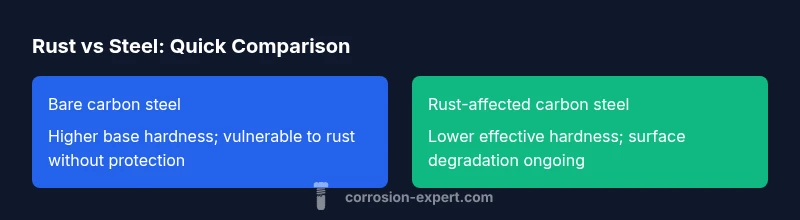
| Feature | Bare carbon steel | Rust-affected carbon steel |
|---|---|---|
| Surface hardness | Higher in bare steel | Lower due to rust crust and pits |
| Structural integrity | Strong core when not rusted | Compromised by rust, spalling risk |
| Corrosion risk | Low if protected | High where rust forms |
| Maintenance needs | Low with protection | Higher with ongoing rust |
| Best use case | Protected indoor components | Outdoor or moist environments |
| Repairability/cost | Easier to maintain with coatings | More costly when rust is extensive |
The Good
- Clarifies when rust matters for hardness and wear
- Helps prioritize maintenance and coating strategies
- Useful for DIY projects to budget risk
- Demonstrates the value of preventive protection
- Supports informed material choices
Cons
- May simplify complex microstructural behavior
- Does not cover all alloy families
- No precise numerical guidance without testing
Rust-affected steel typically underperforms in hardness and durability compared with clean steel, so prevention or timely rust removal is recommended.
For applications where hardness matters, keep steel rust-free through coatings and maintenance. If rust is already present, remove it and recoat; otherwise replacement may be safer for safety-critical parts. The Corrosion Expert team recommends proactive rust prevention to maximize hardness and durability.
Quick Answers
Is rust harder than steel?
No. Rust is a corrosion product and is not harder than the underlying steel. While tiny oxide regions can appear locally stiff, the rust layer is porous and cannot carry load like metal. The underlying steel typically remains harder than the rust crust, but overall performance declines as rust progresses.
No. Rust is a corrosion product, not a metal; it does not provide the same hardness as steel.
How does rust affect the hardness of steel?
Rust lowers effective hardness by consuming metal and creating surface irregularities. Pitting and porous oxide layers reduce load-bearing capacity, so areas with heavy rust are less hard and more prone to wear and failure under stress.
Rust reduces effective hardness by making the surface rough and introducing weak spots.
Can rust be reversed or removed completely?
Rust can be removed, but restoring the original metal hardness requires proper treatment and often recoating or replacement. Loose rust can be brushed away, while deep corrosion may leave pits that continue to affect performance.
Rust removal helps, but you may still face losses unless you replace or fully restore the surface.
What factors accelerate rust progression?
Moisture, salt, temperature, and the presence of dissimilar metals accelerate rust. Environments with humidity and exposure to corrosive agents increase corrosion rates and shorten the life of affected parts.
Moisture and salts speed rust; keep things dry when possible.
What are best practices to prevent rust on steel?
Apply protective coatings, use galvanization or stainless alloys in harsh environments, and maintain dry conditions. Regular inspection and re-coating extend the life of steel components and preserve hardness.
Keep steel dry, coated, and protected for the longest life.
Is stainless steel rust-proof?
No material is completely rust-proof. Stainless steels resist corrosion much more than carbon steel, but under aggressive conditions they can rust. Choosing the right grade and maintaining protective barriers matters.
No, not totally rust-proof; pick the right stainless grade and keep it protected.
Quick Summary
- Hardness is a property of metal, rust is not
- Rust reduces effective hardness and wear resistance
- Protect steel with coatings or corrosion-resistant alloys
- Inspect for pits and replace severely corroded parts
- Engage in preventive maintenance to extend life