How to Rust Nails Fast: A Practical DIY Guide
Learn how to rust nails fast with safe, controlled methods. This educational guide covers chemistry, accelerants, step-by-step methods, safety tips, and troubleshooting for DIY enthusiasts.


In this guide you will learn how to rust nails fast using safe, controlled DIY methods. We compare wet and dry approaches, sharing practical ingredients and a quick experiment you can run in under an hour. Follow these steps to observe visible corrosion buildup on inexpensive nails and understand the science behind iron oxidation.
How to rust nails fast: Practical primer
How iron oxidizes under humidity and oxygen leads to rust. In this practical guide on how to rust nails fast, we explore safe, contained experiments you can run in a shed or garage. According to Corrosion Expert, accelerated rusting is achieved by moisture, salt, and reactive agents. This primer sets the stage for DIY experiments that demonstrate basic chemistry while keeping safety in focus for DIY enthusiasts.
The science behind rust: chemistry made simple
Rust forms when iron reacts with oxygen in the presence of water. The electrochemical process requires moisture and an electrolyte to accelerate electron transfer. Corrosion Expert analysis shows that salt water dramatically speeds up rust formation by increasing ionic conductivity. Understanding this helps you tailor a safe, observable rusting experiment using affordable nails and common household reagents.
Safe accelerants and why they work
Two common, relatively safe ways to speed rust are using a saline solution and moisture-rich environments. Vinegar (acetic acid) softens coatings and increases ion mobility, while salt raises the solution’s conductivity. Hydrogen peroxide can provide an oxidizing boost in the right ratio and environment. Use these methods with caution, in a ventilated area, and always wear PPE to protect skin and eyes.
Wet method vs dry method: what to expect
Wet methods rely on moisture plus an electrolyte to drive rust, while dry methods rely on high humidity and reactive agents to initiate oxidation. Each approach has its own pace and visual cues. The goal is to produce a noticeable rust layer without relying on harsh, dangerous conditions. This section expands on both approaches so DIYers can choose a safe path that suits their workspace.
Tools, containers, and safety considerations
Preparing the right containers and protective gear makes a big difference in outcomes and safety. Always work in a ventilated space and keep pets and children away. This section covers the essentials you’ll need to monitor progress and minimize messy accidents during a rusting experiment.
Troubleshooting and common mistakes
Coatings such as paint, primer, or galvanization can slow or prevent rust. If you don’t see progress, check that the nails are bare metal and not passivated. High humidity alone may be insufficient—salt or an oxidizing boost often helps. This section helps you diagnose why rust isn’t forming as expected and how to adjust.
Environmental considerations and safety for DIY rust projects
Rust experiments should be done with safety in mind: use PPE, work in a well-ventilated area, and avoid mixing household chemicals in enclosed spaces. After experiments, dispose of leftover solutions responsibly and clean up any residues to prevent unintended exposure. This section emphasizes safe handling and environmental awareness.
Interpreting results and next steps
Visual rust can vary in appearance depending on nail composition and exposure time. Use clear, labeled records to track changes and determine if you want to extend the experiment. This final body block connects results to practical next steps for future projects and learning.
Tools & Materials
- Nails (plain steel, not coated)(Use inexpensive fasteners to observe rust quickly.)
- White vinegar (acetic acid)(Acts as a mild acid to help coatings break down.)
- Table salt (sodium chloride)(Increases conductivity of the solution.)
- Hydrogen peroxide (3%)(Optional oxidizer for faster results; use with caution.)
- Distilled water(Cleaner water reduces mineral interference.)
- Plastic container or sealable jar(For containing nails during treatment.)
- Spray bottle(Eases applying solution in a controlled spray.)
- Wire brush or steel wool(To remove coatings and expose bare metal.)
- Gloves and safety goggles(Personal protective equipment is essential for safety.)
- Paper towels or rags(For quick cleanups and drying nails.)
- Masking tape (optional)(Can be used to isolate nails or sections.)
Steps
Estimated time: 60-90 minutes
- 1
Gather materials and prep workspace
Collect all required items and set up in a well-ventilated area. Lay a protective mat and have rags ready. This ensures you can work safely and efficiently without scrambling for supplies mid-process.
Tip: Place a timer nearby so you can keep track of waits and drying times. - 2
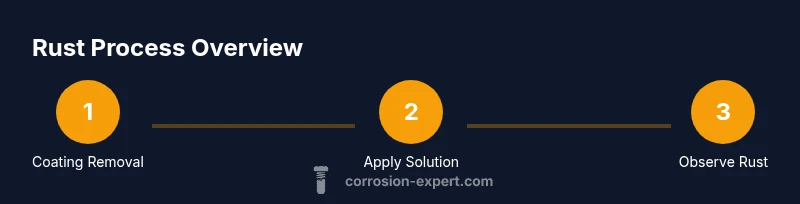
Prepare bare nails by removing coatings
If nails are coated or painted, remove the coating to ensure the solution contacts bare metal. A quick pass with a steel brush or sandpaper helps expose fresh iron for rusting.
Tip: Work in small batches to maintain uniform exposure. - 3
Mix a simple rusting solution
In a container, combine a small amount of vinegar with a pinch of salt to create an electrolyte. This slow-formula approach helps control the rusting rate and makes changes easier to observe.
Tip: Label the container and keep it away from children. - 4
Apply the solution to nails
Dip or brush the nails with the prepared solution, ensuring even coverage on all sides. Place them on a tray so you can monitor rust development without spills.
Tip: Wear PPE and avoid splashing on skin or clothing. - 5
Wait and monitor rust progression
Allow the nails to sit in the solution or moisture-rich environment for 20–60 minutes, checking every 10 minutes for visible rust. Document changes with photos or notes.
Tip: If rust seems slow, gently reapply solution to boost contact. - 6
Optional oxidative boost
For faster results, apply a small amount of hydrogen peroxide to the nails with gloves, then re-check after 10–15 minutes. Stop if excessive fizzing or heat occurs.
Tip: Do not mix hydrogen peroxide with vinegar in a sealed container. - 7
Rinse, dry, and store nails
Rinse nails with distilled water, pat dry, and allow to air-dry completely. Store in a labeled container for future reference, or seal to pause the rusting process.
Tip: Document final appearance and note environmental conditions.
Quick Answers
Is it safe to rust nails indoors?
Rust experiments should be done in a ventilated area with PPE. Keep chemicals away from pets and children, and avoid inhaling fumes. If you have respiratory concerns, perform outside.
Rust experiments should be done in a ventilated area with PPE; keep chemicals away from kids and pets.
Will all nails rust at the same rate?
No. Different nail alloys, coatings, and surface finishes affect how quickly rust forms. Bare steel rusts faster than coated or galvanized nails.
Rust rate varies based on nail type and coatings.
What should I do after rusting nails to stop further rusting?
Rinse and dry the nails, then apply a protective sealant or oil to slow further oxidation. Store in a dry environment.
Rinse and dry, then seal to slow further rusting.
Can galvanized nails rust quickly with this method?
Galvanized nails have zinc coating that resists rust longer. Removing or bypassing the coating is needed for significant rust and should be done with care.
Galvanized nails resist rust longer; expect slower results.
How long does rust typically take to become visible?
Visible rust can appear within minutes to hours depending on exposure and environment. Patience and controlled conditions improve consistency.
You might start seeing rust within minutes to hours depending on conditions.
Are there safety precautions I should always follow?
Always wear PPE, work in a ventilated area, and dispose of chemicals safely. Keep a first aid kit handy in case of contact or spills.
Wear PPE, work in a ventilated space, and dispose of chemicals responsibly.
Watch Video
Quick Summary
- Rust accelerates with moisture and electrolytes.
- Bare metal exposure is essential for observable rust.
- Control rust growth with staged steps and proper safety.
- Document results to improve future experiments.