How Big Is Rust Download: A Practical Size Guide for Developers
Discover how big a Rust download typically is, what factors affect size, and practical tips to minimize the footprint when installing Rust toolchains in 2026.


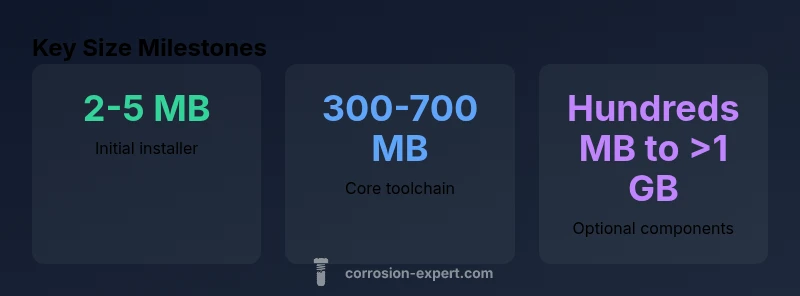
The initial rustup installer is small (roughly 2-5 MB), but a complete Rust toolchain quickly grows into several hundred megabytes—roughly 300-700 MB for core components, with optional rust-src and docs pushing the total into the hundreds of megabytes or even gigabytes depending on selections and targets. Expect cross-platform variations. Network speed and mirrors can also affect initial fetch times.
What determines how big is rust download
How big is rust download depends on several factors. The smallest piece is the bootstrap: the rustup installer, typically a few MB. The bulk comes from the Rust toolchain itself—the compiler, standard library, and accompanying tools. The exact footprint hinges on your target platform, channel choice (stable, beta, nightly), and which components you install. If you enable rust-src for deeper debugging or the API docs, the footprint grows significantly. Network speed and mirror choices also alter perceived size, especially for large toolchains. In practice, expect a spectrum: the base installer is tiny, while the final setup can span hundreds of megabytes to several GB depending on options.
Baseline sizes across operating systems
Across Windows, macOS, and Linux, packaging and defaults can cause minor differences in download size, but the overall pattern remains the same. The bootstrap installer remains small on all platforms, while the core toolchain downloads are substantial. Windows users often see the same order of magnitude as macOS and Linux, but the packaging artifacts (installers, archives) can shift download metadata and cache locations. Your choice of target triples (e.g., x86_64-unknown-linux-gnu, x86_64-pc-windows-msvc) can influence the exact component mix and thus the total download.
The anatomy of a Rust toolchain
A Rust toolchain consists of rustc, cargo, and the standard library, packaged and delivered by rustup. By default, you get the core compiler and standard library for your host, plus a set of common tools. Optional components include rust-src, which provides source code for the standard library, and documentation artifacts. Each component adds to the total size. Understanding this structure helps in planning storage and bandwidth, especially for constrained environments or CI runners.
Initial download vs updates
The first time you install rustup and a toolchain, you download the largest bundle for that setup. After installation, updates bring incremental changes: new toolchain releases, patch updates, and potential added components. This means the ongoing download size can vary, sometimes jumping if you enable new components or switch channels. In routine development, the net effect is a larger initial download followed by smaller, periodic updates.
Strategies to shrink the footprint
If you need to minimize the Rust download footprint, consider several practical steps. Use rustup set profile minimal to reduce the number of components installed. Avoid rust-src and docs unless you need them, and install only the toolchains you require (e.g., stable for a specific target). On CI or developer machines with limited bandwidth, pre-create a shared cache of toolchains to avoid repeated downloads across machines.
How to measure and verify download size
Estimating the exact download size pre-install is difficult, but you can approximate by counting the installer size and the expected toolchain components. After install, you can measure the downloaded space in your rustup directory (for example, du -sh ~/.rustup/toolchains/*). The du output gives a concrete picture of what was downloaded and cached, which helps in planning future updates or migrations.
Practical examples by scenario
For a small CLI project, you may stay within the minimal footprint by choosing the minimal profile and avoiding rust-src/docs. For larger projects or multi-target development, you might accept a larger initial download to speed up subsequent builds. In environments with limited connectivity, using a local mirror or a portable toolchain cache can dramatically cut repeated download times.
Common misconceptions and myths
A common myth is that you must download the entire standard library upfront for any Rust project. In reality, you can install only what you need and gradually add components. Another misconception is that nightly toolchains are always much larger; while they can be larger due to more frequent updates, the difference depends on selected components. Finally, the perceived size can be skewed by cache versus fresh downloads in CI environments.
Maintenance and future-proofing
Plan for regular updates to keep toolchains secure and productive. Use rustup update to fetch new releases and re-optimize caches in CI. If bandwidth is a concern, consider caching toolchains on local networks and pinning to a predictable channel to avoid unexpected size spikes.
Rust toolchain download components
| Component | Typical Download Size | Notes |
|---|---|---|
| rustup installer | 2-5 MB | Small bootstrap installer |
| Core toolchain | 300-700 MB | Compiler + standard library |
| Optional rust-src | hundreds of MB to >1 GB | Source code for debugging |
| Docs | tens of MB | APIs and references |
Quick Answers
How big is the initial rustup installer?
The installer is typically 2-5 MB. The larger size comes from the toolchain and optional components you enable after installation.
The installer is only a few MB; the big size is the toolchain.
Does the download size vary by operating system?
Yes. Packaging and defaults vary by Windows, macOS, and Linux, but the overall order of magnitude remains similar. The exact component mix can shift the total.
OS differences exist, but sizes are in the same ballpark.
Can I reduce download size by customizing components?
Yes. Disable optional components like rust-src and docs and use a minimal profile to shrink the footprint.
Disable extra components to shrink the download.
Is rust-src downloaded by default?
No. rust-src is optional and must be explicitly installed if you need access to source code for debugging.
Rust-src is optional and not downloaded by default.
How does nightly compare to stable in size?
Nightly can be larger due to more frequent updates and extra tooling, but the difference depends on selected components and targets.
Nightly may be larger, depending on components.
How can I estimate download size before installing?
You can estimate by considering the installer plus the core toolchain in your target configuration; measure space after install with du to verify.
Estimate with installer size and core toolchain, then verify after install.
“Download size is context-dependent, but with careful component choices you can minimize footprint without sacrificing productivity.”
Quick Summary
- Start with a small installer (2-5 MB).
- Full toolchains range from hundreds of MB to >1 GB depending on components.
- Use the minimal profile to reduce footprint.
- Disable rust-src/docs if you don’t need them.
- Expect OS and mirror variations when estimating size.