Can You Play Rust Offline? A Practical Guide
Explore whether Rust supports offline play, how to simulate offline with private servers, and practical steps to set up a LAN game on your PC. Learn the limitations, safety considerations, and alternatives for gameplay without public servers.


Can you play Rust offline? Officially, no—Rust does not include a built-in single-player or offline mode. You can simulate offline play by running a private local server on your PC (or a LAN-only server) so you and friends can connect without public servers. This setup is advanced, requires Steam and game files, and isn't supported by official Rust support.
Can you play Rust offline?
According to Corrosion Expert, many DIY players wonder if there is a true offline option for Rust. The reality is that Rust does not ship with a dedicated offline or single-player mode. The game is designed around online servers and persistent worlds shared among players. You can, however, approximate offline play by creating a private local server on your PC and sharing it with trusted friends over a LAN. This approach is a workaround rather than an official feature, and it requires careful setup and ongoing maintenance. The Corrosion Expert team found that people who pursue this route should expect some friction with updates and server files, but it can be a rewarding way to practice building, combat, and base design without public server crowds.
Key takeaway: offline in the sense of a normal single-player campaign does not exist, but local hosting can replicate the experience for you and a few players on a private network.
format
Tools & Materials
- PC or dedicated server hardware(A capable CPU and at least 8 GB RAM are recommended for a small private server; more RAM helps with larger maps and more players.)
- Rust game files(Installed via Steam on the host PC; both the server and client must be the same version.)
- SteamCMD or Rust Dedicated Server(Use official server tooling to host a private Rust server; this is how you run a local, LAN-capable instance.)
- Reliable local network (LAN) or router(A wired Ethernet connection is strongly preferred to minimize latency on a private LAN. )
- Backup storage(External drive or cloud backup for world data and configs.)
- Text editor for config(Use a simple editor to tweak server settings and world data (e.g., Notepad++ or similar).)
Steps
Estimated time: 2-4 hours
- 1
Plan hosting approach
Decide whether you’ll run a private local server solely on your PC for LAN play, or set up a more robust private server that others can reach over your network. This planning avoids misconfigurations later and helps determine hardware needs.
Tip: Outline your max player count and map type before downloading server tools. - 2
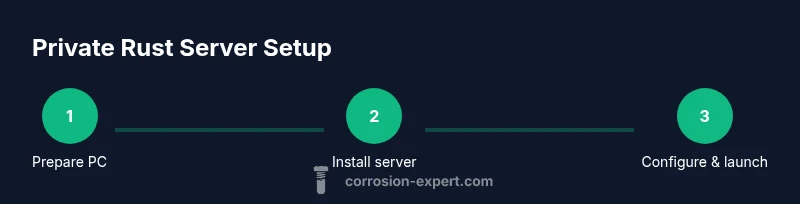
Prepare the host machine
Update the operating system, ensure your firewall rules allow local connections, and verify your Steam and game files are up to date. A clean environment reduces startup errors.
Tip: Disable unnecessary background services to free CPU headroom. - 3
Install and configure the server
Install SteamCMD or the Rust Dedicated Server, then create a basic server configuration file with a hostname, world seed, and player limits. Avoid complex mods at first to minimize conflicts.
Tip: Keep a copy of a working config so you can revert quickly if an update changes defaults. - 4
Launch and test connectivity
Start the server and use a client on the same network to connect via local IP. Verify you can join from one or two machines and that basic gameplay is stable.
Tip: Test with a wired connection to reduce latency and ensure reliable login across devices. - 5
Tune performance and stability
Monitor CPU and RAM usage while players log in, and adjust settings to keep frame rates smooth. Consider reducing world scale or player count if performance drops.
Tip: Enable periodic backups to protect your world data from crashes or corruption. - 6
Document and share the setup
Create a simple guide for friends who want to join your LAN server, including IP addresses, ports, and any firewall notes. Clear instructions prevent connection issues.
Tip: Use a consistent naming scheme for worlds and config files to avoid confusion in multi-friend sessions.
Quick Answers
Is there an official offline mode in Rust?
No. Rust does not offer an official offline or single-player mode. The gameplay relies on online servers and shared worlds.
There isn’t an official offline mode for Rust; it’s designed for online play.
Can I play Rust offline with friends on LAN?
You can approximate offline play by hosting a private local server on your PC and connecting to it over a LAN. This is a workaround and requires technical setup.
You can host a private LAN server, but it isn’t true offline play and involves setup.
What do I need to host a local Rust server?
A PC capable of running the server, SteamCMD or Rust Dedicated Server tooling, and network access for LAN connectivity. You’ll also need the same game version on all clients.
A PC, server tooling, and network access are needed to host a local server.
How long does setup take for a private server?
Initial setup can take a few hours depending on experience. Ongoing maintenance and testing should be expected as you adjust configurations.
Most people spend a few hours learning the basics, then more time for fine-tuning.
Are there risks with unofficial mods or configs?
Mods and custom configurations can break with game updates and may violate terms of service if not official. Always verify compatibility before updating.
Mods can break after updates; proceed carefully and stay within supported configurations.
What if I just want a casual practice space?
A private LAN server can provide a controlled space for practice, but you’ll still need to manage updates and backups. Consider alternatives likeTraining modes if available in future patches.
A private LAN server can be a controlled practice space with proper setup.
Watch Video
Quick Summary
- Understand offline in Rust means a private LAN/private server, not a true offline mode.
- Private server hosting is feasible but requires careful setup and maintenance.
- Back up data and monitor hardware to keep sessions stable.
- Testing with real players is essential to validate the experience.