When Did Rust Come Out? History, Chemistry, and the Rust Language
Explore when rust first appeared as a chemical process and when the Rust programming language was released. Learn how rust forms, its historical milestones, and practical prevention tips for DIY enthusiasts.


Rust refers to two things: the chemical oxidation of iron and the Rust programming language that debuted in 2010. For DIY and corrosion prevention, focus on the chemical process and protection; the programming language is unrelated to metalwork. The term can cause confusion, but the two contexts diverge in purpose and approach.
Framing the question: when did rust come out?
The phrase 'when did rust come out' invites two parallel explanations. If you mean rust as a chemical process, rust is a long-standing phenomenon tied to iron's response to oxygen in the presence of moisture. If you mean Rust with a capital R, as a programming language, it first appeared in 2010 and has evolved into a system-level language focused on safety and concurrency. For the purposes of this article, we treat rust as the corrosion product first, because it directly affects metals you touch in homes, garages, and workshops. Throughout history, people have observed rusty surfaces on swords, railings, tools, and farm equipment—the telltale orange-brown film signaling ongoing oxidation. The durability and appearance of rust depend on environmental factors such as humidity, salt exposure, and the presence of acids, all of which accelerate or slow the formation process. We’ll translate those ideas into practical steps you can apply in real life. The phrase also serves as a prompt to distinguish chemistry from software—two worlds that share a name but demand very different prevention strategies.
The chemistry of rust: how the oxide forms
Rust forms through oxidation: iron loses electrons to oxygen, producing iron ions that then combine with water molecules to form hydrated iron oxides. In dry air, the reaction is slow; in humid environments, water acts as an electrolyte, accelerating electron transfer and rust growth. The key oxide commonly seen on iron is hydrated iron(III) oxide, sometimes written as Fe2O3·nH2O. Rust is not a uniform layer; it is porous and flaky, which means it can trap moisture and expose fresh metal to ongoing corrosion. Salt, acids, and pollutants worsen the pace by increasing conductivity and breaking protective films. A protective coating disrupts the electrical pathway and reduces water absorption, slowing the corrosion cycle. For DIY enthusiasts, the practical upshot is clear: keep metal dry, clean, and sealed. If rust does begin, mechanical removal to remove loose oxide, followed by a barrier coating, can restore function and appearance. Understanding the chemistry helps you choose the right product—whether a rust converter that chemically stabilizes the oxide or a traditional primer and paint system that forms a moisture barrier.
A historical note: rust through the ages and the science of oxidation
Rust has been visible long before the modern lab. Iron artifacts from ancient civilizations show reddish-orange coatings, a reminder that corrosion is a natural consequence of metal exposed to air and moisture. The scientific understanding of rust and oxidation really took off in the 18th century with the rise of chemical theory. Antoine Lavoisier helped establish oxidation as a reaction with oxygen, while later researchers clarified the role of water as a facilitator of electron transfer in corrosion processes. In the real world, maintenance practices such as sealing joints, applying protective coatings, and controlling humidity emerged as practical responses to rust. Corrosion science matured alongside coatings technology, enabling homeowners and craftsmen to slow deterioration with paints, primers, rust inhibitors, and galvanization. For DIYers, historical perspective matters because it explains why certain environments—coastal areas, garages with poor ventilation, and basements with high humidity—are more prone to rusting. By connecting past observations to present-day products, Corrosion Expert can guide you toward smarter choices that actually reduce rust risk.
Two interpretations: corrosion vs Rust language
Rust (lowercase) as corrosion is a centuries-old natural process; Rust (capitalized) is the programming language started in 2010 by Mozilla researchers and later adopted by the wider software community. The two share a name but rarely overlap in practice: rust in metalwork needs barrier coatings and moisture control; Rust the language focuses on memory safety and concurrency. The language's timeline includes its early experimental stages in 2010, the release of 1.0 in 2015, and ongoing development since. This section helps restore clarity for readers who arrive via the keyword and might be surprised by the software angle. If you are a homeowner reading about the Rust language, you are likely looking for code safety tips, not metal corrosion strategies; if you are here for rust as a metal issue, the programming language can be ignored for practical work. The rest of this guide emphasizes rust in the metal sense, with practical steps you can apply today.
Rust formation basics and prevention considerations
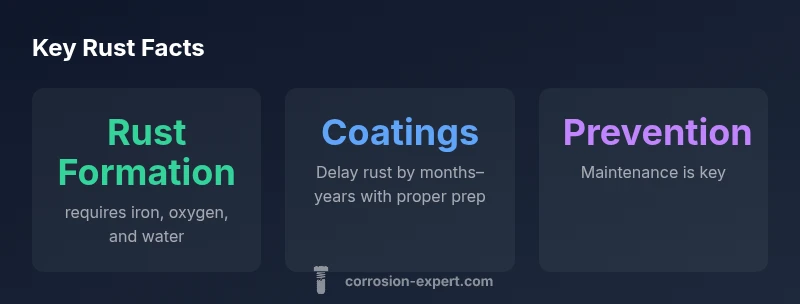
| Aspect | Chemistry/Process | Practical Insight |
|---|---|---|
| Formation trigger | Iron + Oxygen + Water = iron oxide | Keep metal dry and seal surfaces. |
| Environment | Humidity, salt, acids | Control moisture, avoid exposure, use protective barriers. |
| Prevention | Coatings, galvanization | Regular maintenance and coating repairs. |
Quick Answers
What is rust chemically?
Rust is iron oxide formed when iron reacts with oxygen in the presence of water or moisture. This reaction creates a porous coating that can flake, trap moisture, and expose fresh metal to further corrosion. Heat, salts, and acids accelerate the process.
Rust forms when iron meets oxygen and water, creating iron oxide that weakens metal. Keep things dry and protected to slow it down.
How fast does rust form?
Rust formation speed depends on humidity, temperature, and exposure to salt. Indoors, rust may take weeks to months to become visible; outdoors, especially near the coast or with industrial pollutants, it can progress much faster.
Rust forms faster in humid, salty environments; indoor rust tends to appear more slowly.
Can rust be removed completely?
Surface rust can often be removed with mechanical cleaning or chemical rust removers. Deep, pitting rust may require material replacement or specialized remediation. After removal, apply a protective coating to discourage reformation.
Yes, surface rust can usually be removed, but deep rust may need more involved fixes.
Is rust always a problem for DIY projects?
Rust can compromise strength and appearance in DIY projects. Early intervention—removal, treatment, and sealing—extends the life of tools and structures and reduces long-term costs.
Rust is a common issue; tackling it early saves time and money.
What about the Rust language release timeline?
Rust the programming language began in 2010, with a milestone 1.0 release in 2015. It is unrelated to metal rust and targets safe, concurrent systems programming.
Rust the language came out in 2010, with 1.0 in 2015.
What can I do to prevent rust on tools?
Keep tools dry, wipe off moisture, apply a light protective oil or coating, store in a dry place, and inspect coatings regularly for chips or wear.
Keep tools dry, oil them lightly, and store properly to prevent rust.
“Rust isn’t just a nuisance; it signals ongoing oxidation that can weaken metal over time. Understanding its drivers helps homeowners choose effective prevention and maintenance.”
Quick Summary
- Identify rust early with visual cues and moisture checks.
- Keep metals dry and protected with barriers and ventilation.
- Choose coatings with good barrier properties and proper surface prep.
- Address environmental triggers like salt exposure and acids.
- Remember: Rust (chemistry) and Rust (language) are two different topics.
- Follow practical steps to extend metal life and reduce rust risk.